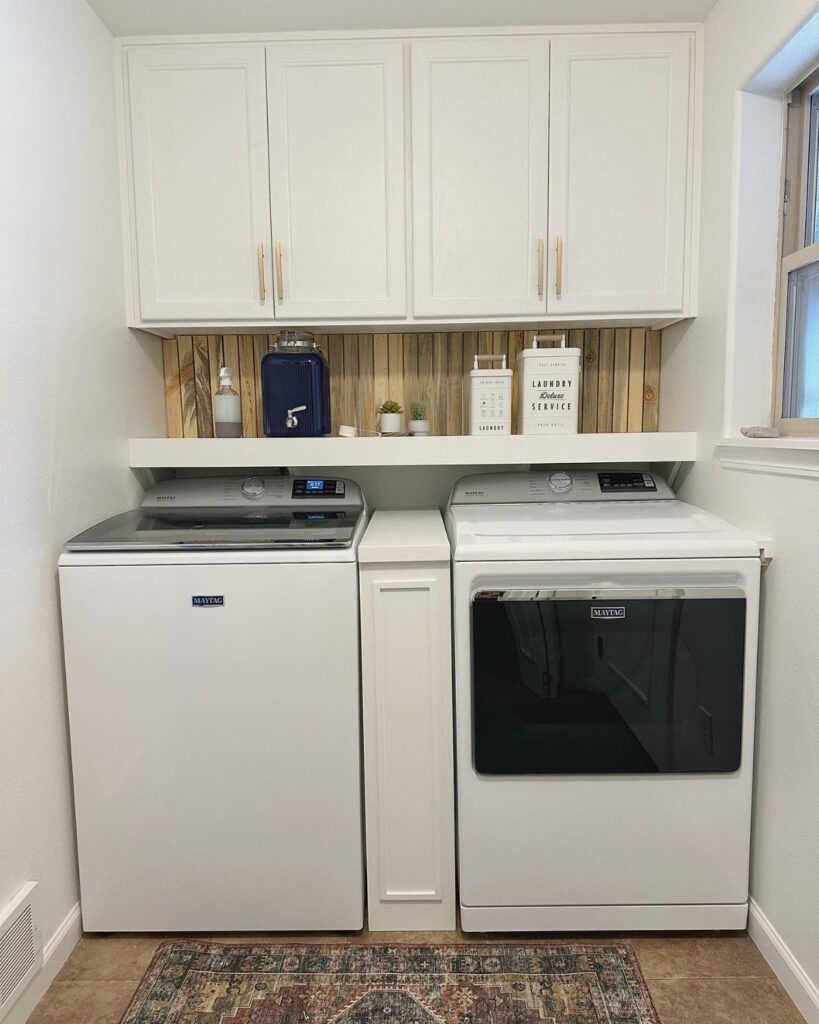
A top loader’s lid swings upward, so the clearance above the machine decides every idea here, from a countertop over the washer and upper cabinets with a floating shelf to open wire shelving and wall-mounted drying racks.
The ideas range from open wire shelving with baskets and a few wall-mounted drying racks up to a raised platform with a double sink, which is the priciest build because of the plumbing and tile.
Measure how far the lid travels when fully open, and pick the idea that leaves that arc clear, plus 6 inches behind the washer for the hoses and shut-off valves.
1. Outdoor Top-Loader Laundry Station
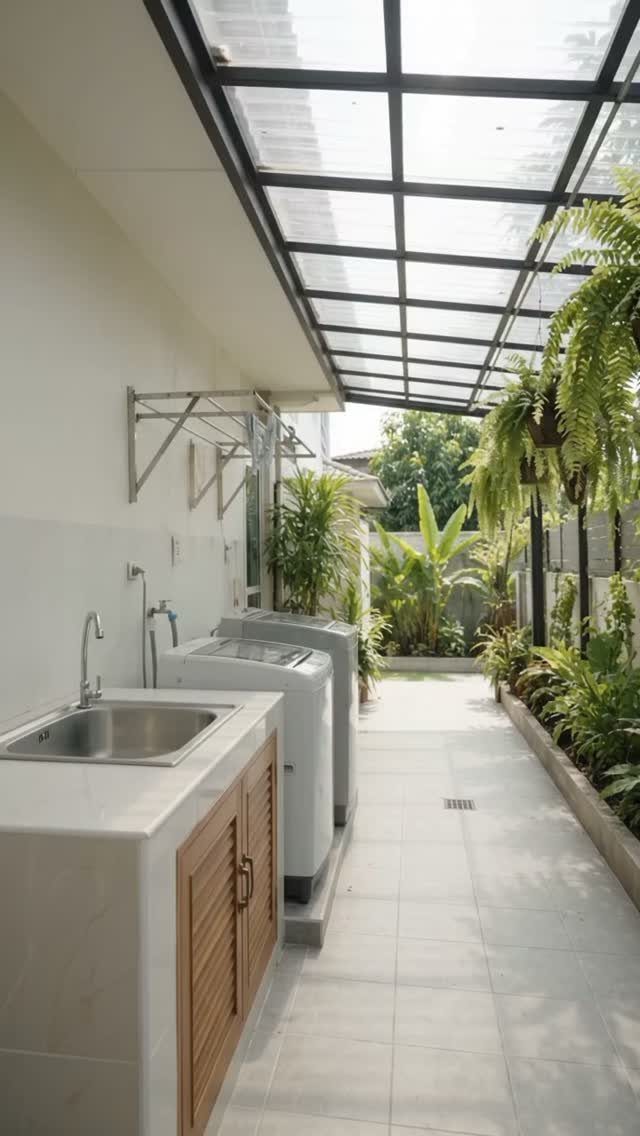
A covered outdoor laundry station suits a top loader well, because the lid opens upward and needs no door swing, so the machines can sit tight against a counter.
A sink with cabinets alongside is where stains get pretreated, and the counter keeps detergent bottles off the washer lid.
Cover the station with a roof before you worry about walls, since rain and direct sun do the most damage to a machine outdoors.
Translucent panels keep rain off the machines while letting daylight in, which beats a solid roof over a space with no windows.
Wood cabinets look great, but I would seal them well, since outdoor air is rougher on them than a laundry room is.
Check that the outlet is rated for outdoor use and that water lines are protected before you commit to the spot.
2. Countertop Over Top Loader
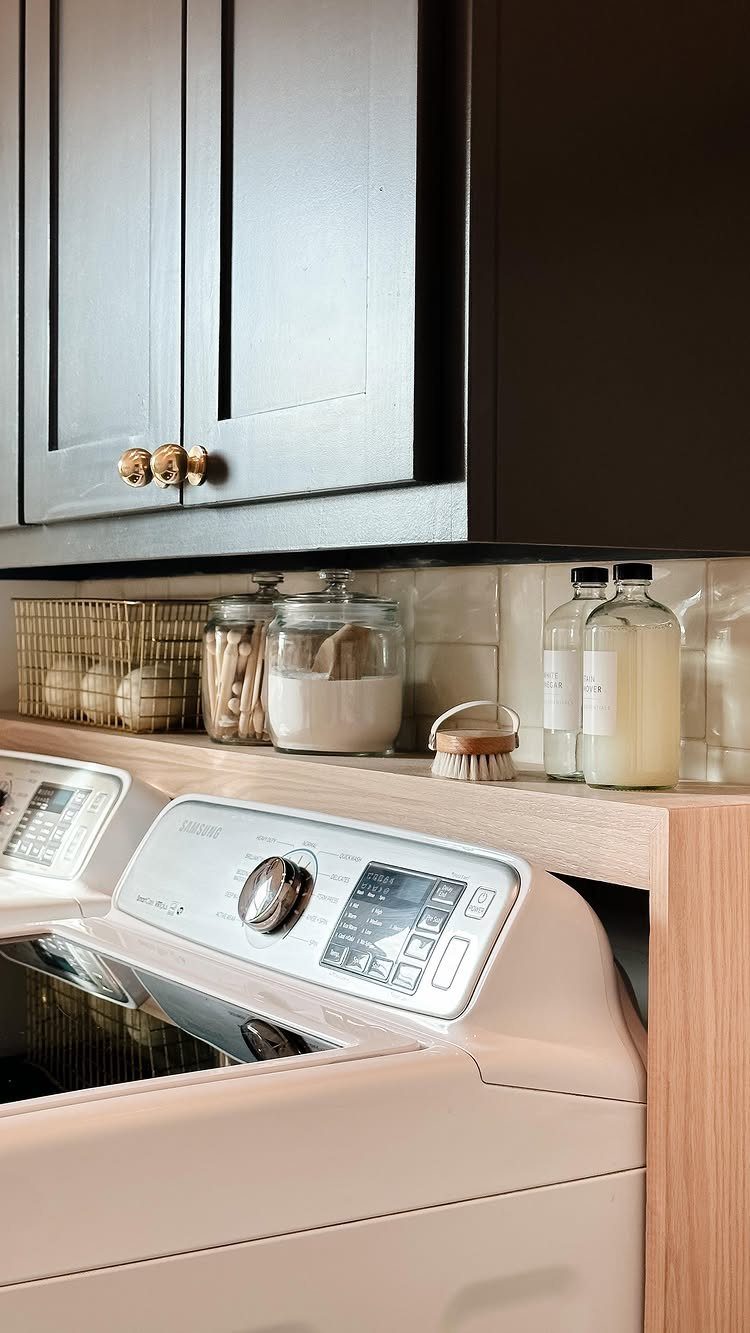
Above a top loader, a wooden countertop only works if you can still lift the lid.
Measure from the machine’s top to the underside of the counter with the lid fully open, and leave a little extra so it never knocks.
Butcher block is my pick for a budget build: it cuts to length at home with a circular saw, and a coat of sealant protects it from splashes.
Rest it on a rail or ledger screwed into the wall studs, not on the washer itself.
The counter then becomes a folding spot, and upper cabinets and a tile backsplash behind it take care of the rest of the wall.
3. Upper Cabinets and Floating Shelf
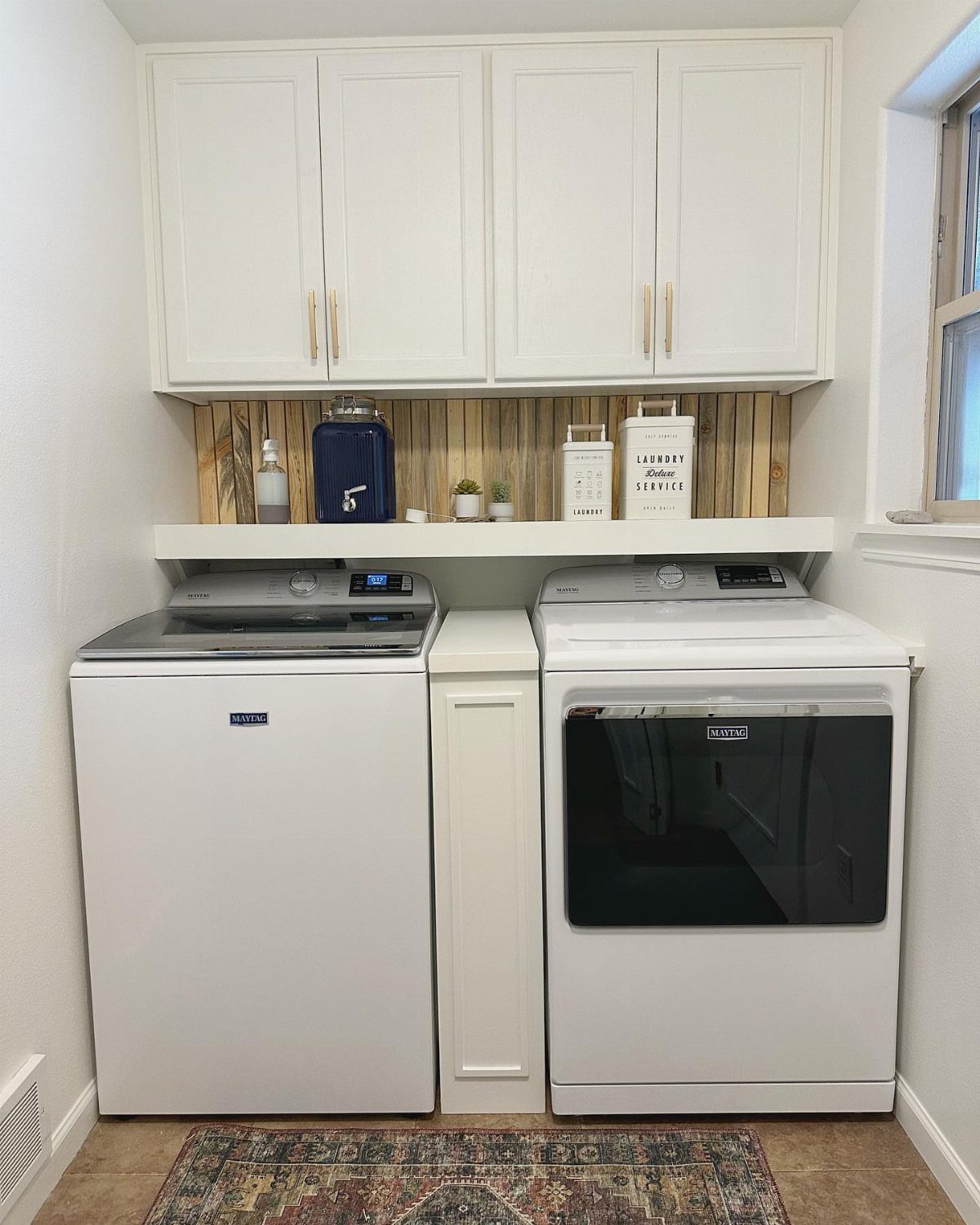
Side-by-side machines leave the wall above them free, and white upper cabinets plus one floating shelf use it well. Cabinets hide detergent and dryer sheets; the shelf holds the things you want to see.
Mount the cabinets high enough that you can lean over the washer and open the lid without hitting the bottom edge. I would hang the shelf below the cabinets only if that clearance survives.
A wood backsplash behind the machines adds warmth to an all-white room, and it is a quick weekend panel job. Keep the shelf decor light, since a heavy piece on a vibrating wall will creep.
4. Raised Platform with Double Sink
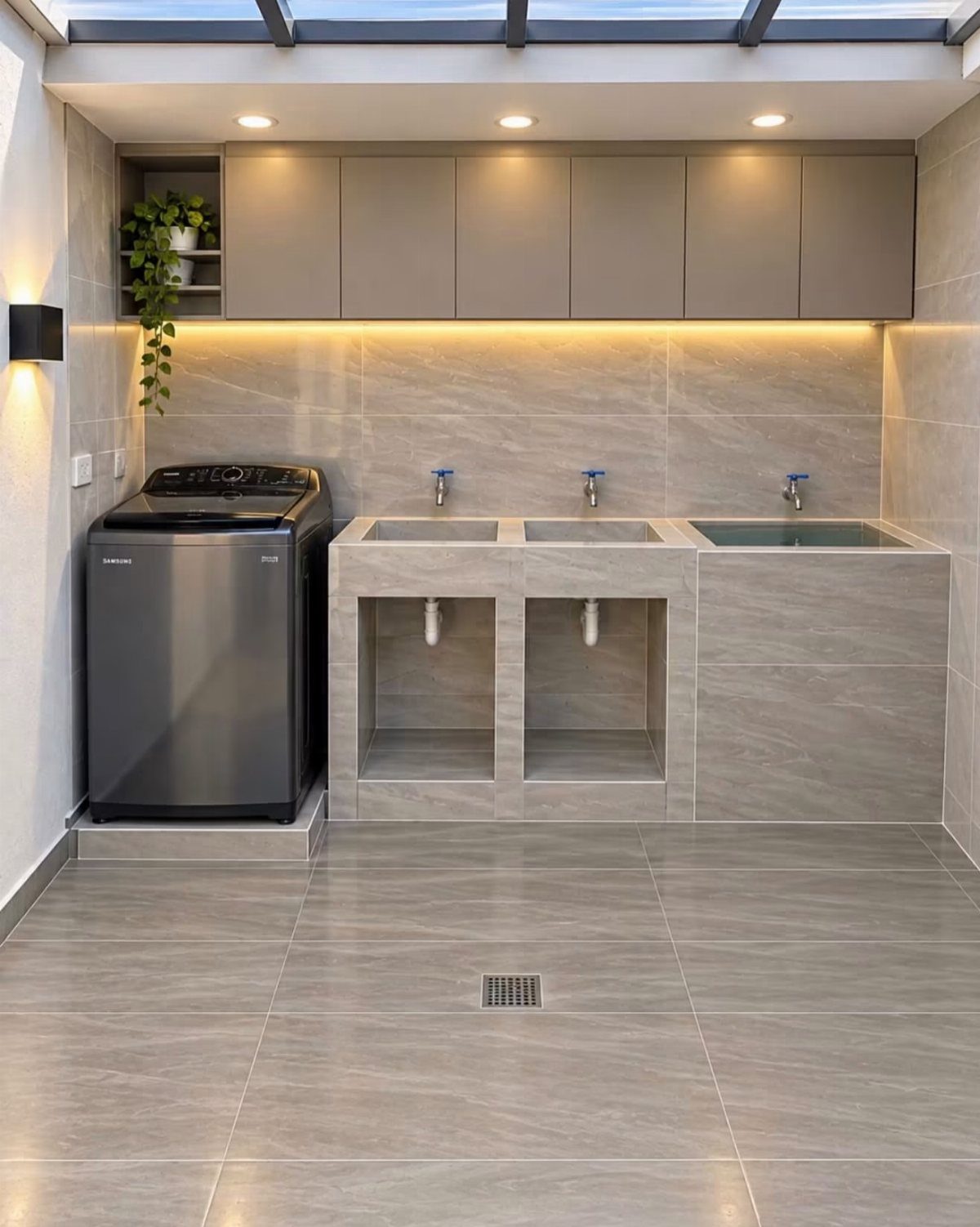
A platform under a top loader leaves room beneath for bins or a drain pan, though it also lifts the drum opening, so reaching to the bottom of the tub gets harder.
A double utility sink beside it means soaking and rinsing happen without leaving the machine.
Build the platform from framed lumber with a solid top, and confirm it carries the washer’s weight when it is full and running. Mount the platform low enough that the lid, once raised, still clears the cabinets overhead.
This is the priciest idea on my list, thanks to the plumbing and tile. If the budget is tight, a single deep sink gets you most of the benefit.
5. Open Wire Shelving with Baskets
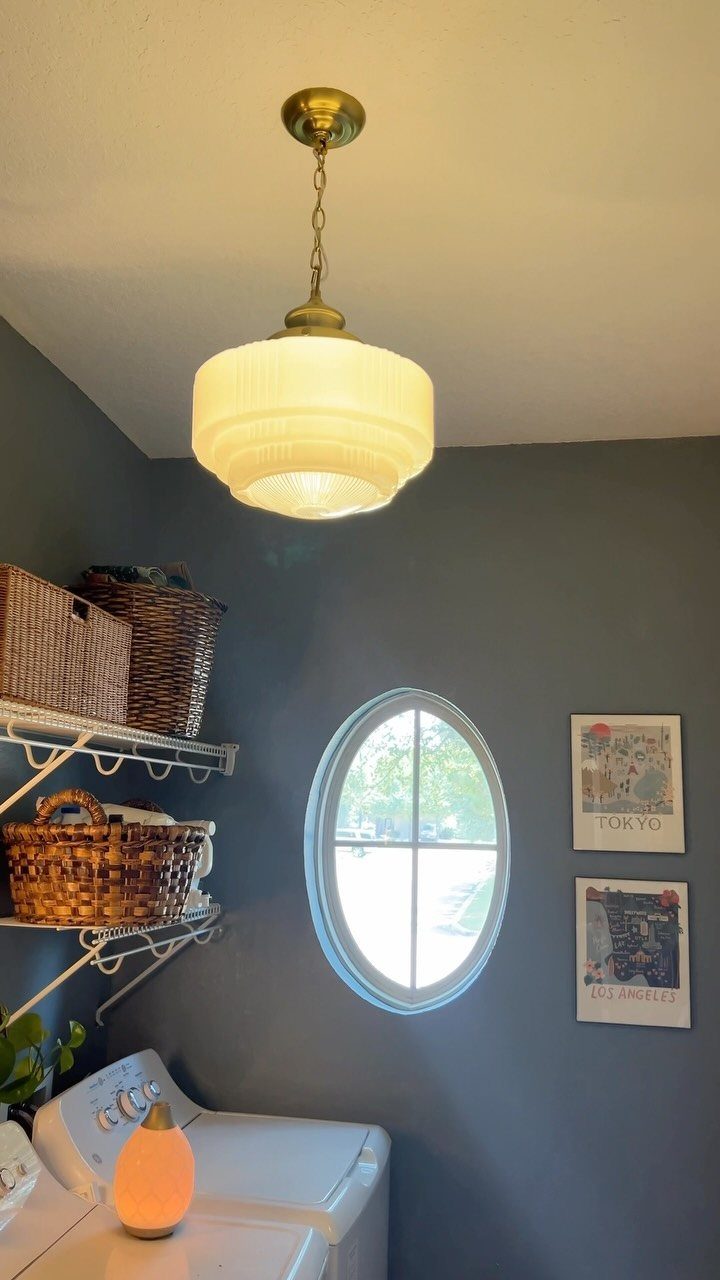
Wire shelving costs less than almost any other storage you can hang over a top loader, and in a room with a window the open design lets light pass through.
Woven baskets hide the clutter and give each category a home: dryer sheets, stain sticks, spare socks.
Leave enough clearance over the machine so the lid can swing all the way up; measure that before you drill. Label baskets on the front, because identical ones turn into mystery boxes fast.
Wire shelves hold lighter loads than solid wood, so keep heavy jugs of detergent on the lowest shelf. Add a hanging light for a finished look.
6. Wall-Mounted Drying Racks
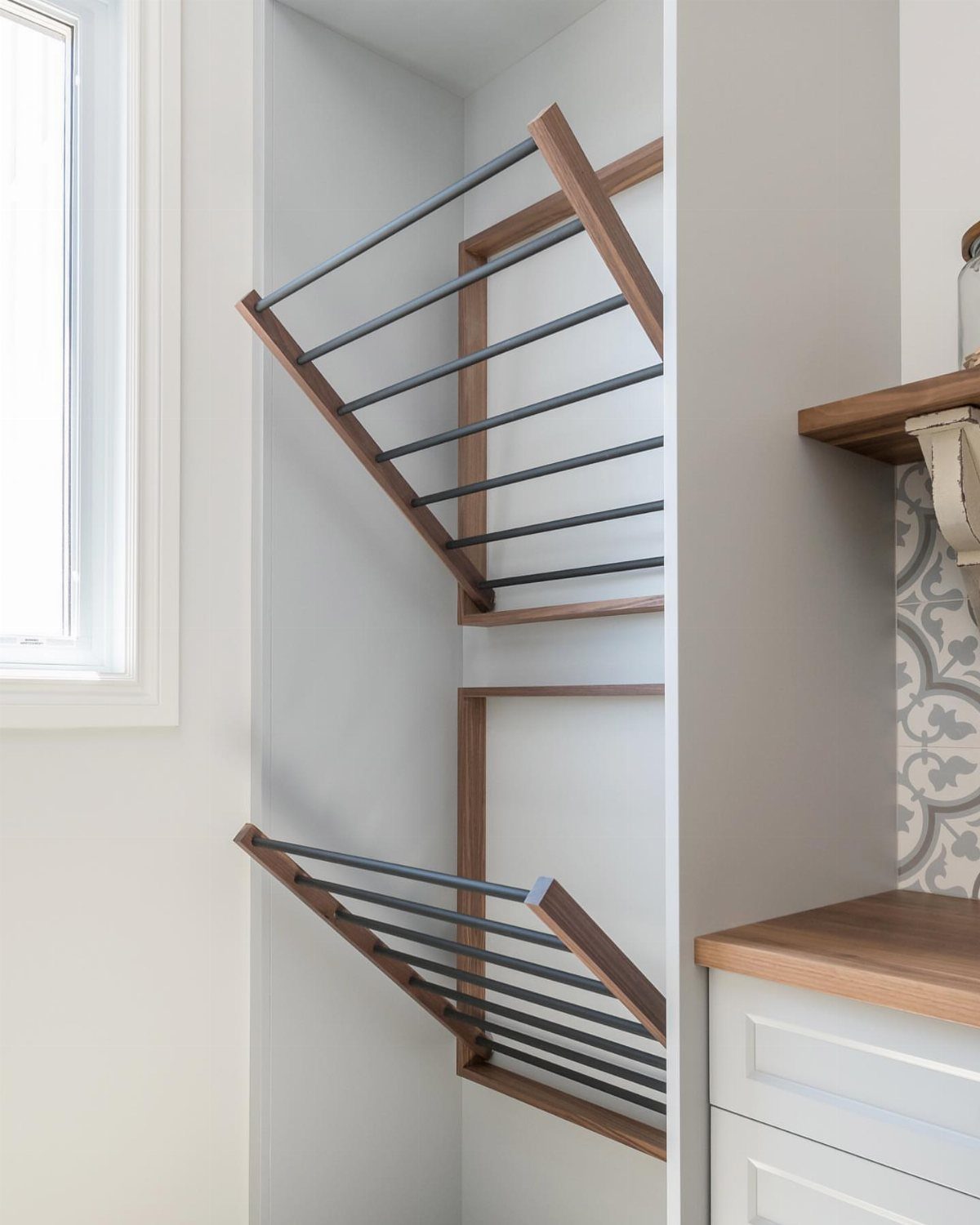
Folding drying racks mounted flat to the wall use airspace you are not using anyway, and they fold away when empty. Wood and metal versions look good enough to leave up in a laundry nook.
Mount them into studs, not just drywall, since wet clothes are heavier than they look. Space them so the arms can swing fully open without hitting the counter beside them.
In tight quarters I choose a wall-mounted rack over a freestanding one, because it keeps the floor clear. Use it for delicates and sweaters that should not go in the dryer.
Importance of Airflow
Water sits in the drum after a cycle, and if air can’t move through the room, that dampness becomes mold and a sulphur stink. Leave at least a 4-inch gap around and above the machine so that moisture can evaporate.
A low shelf or a tight enclosure is the usual cause. If the lid sits open between loads, air moves through the drum and it dries out faster.
Measure how far the lid swings back when it’s fully open, then keep any shelf above it an inch or two shallower than that arc. Hang a rod at least 36 inches above the back control panel.
A short stool tucked next to the washer brings the top bin within reach without climbing. A shallow bin up there collects dryer lint if the nearest trash is across the room.
Plumbing Access Considerations
Sliding the washer flush to the wall looks clean, but you lose access to hoses and the space you need when something leaks. Top loaders vibrate hard on the spin cycle, and hoses pressed against drywall chafe over time.
Leave at least 6 inches behind the washer. That gap is where the shut-off valves and drain standpipe live, and you should be able to reach those valves in seconds if a hose lets go.
It looks a little less polished. A flooded floor looks worse, and a kinked hose is one of the likeliest causes.
Avoiding Countertop Traps
A fixed counter over a top loader is often a mistake. The lid ends up barely opening, the bleach dispenser is hard to reach, and the drum gets too little air to dry between cycles.
A removable surface solves most of this. A loose butcher block counter sitting on wall cleats lifts away when you need to reach the controls or wipe down the rim.
A fold-down table mounted to the side wall gives you a work surface without boxing in the machine.
Frequently Asked Questions
What are some ideas for a very small laundry room?
Use the wall space above the machine, and leave the lid’s path clear.
Wall-mounted folding drying racks take over airspace that sits empty anyway and fold flat when idle, while cheap open wire shelving with labeled baskets handles detergent and supplies.
If you want a work surface, a fold-down table on the side wall beats a fixed counter.
Is 5 feet wide enough for a laundry room?
It can work, but only if you protect the few clearances a top loader needs.
Plan on roughly 6 inches of depth behind the washer for hoses and shut-off valves, plus 4 inches of clearance on the sides and top so air can move.
Any shelf or cabinet overhead has to sit high enough that the lid opens all the way. Wall-mounted racks and a fold-down table keep the floor open in a narrow room.
Can I put a countertop over a top-loading washer?
Yes, but only if the lid still opens fully. With the lid propped fully open, measure from the machine’s top edge to the counter’s underside, then pad that number slightly so the lid never bumps.
A fixed counter tends to restrict the lid and cut airflow, so the drum dries slowly.
How much space should I leave behind a top-loading washer?
Plan on 6 inches at minimum. Shut-off valves and the drain standpipe live in that space, and if a hose gives way you want your hand on those valves within seconds.
Spin cycles shake a top loader hard, and hoses squeezed against the drywall will fray over time. Pushing the machine flush looks tidier but costs you that access.





