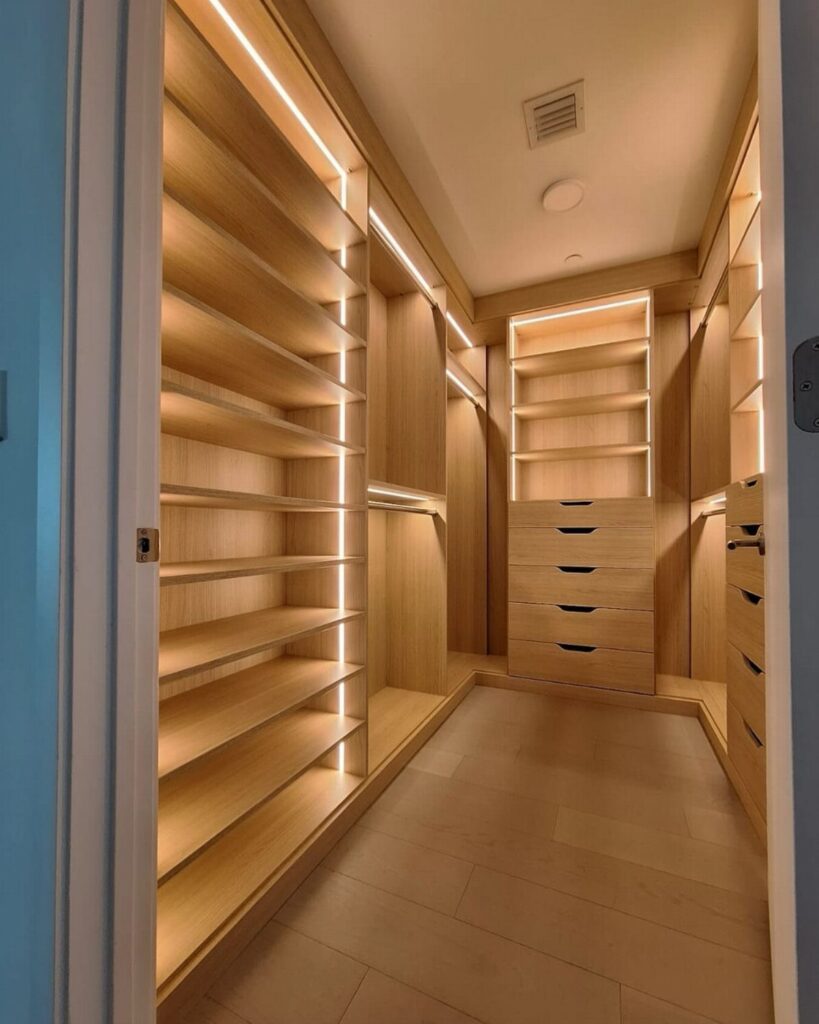
Ideas here run from stick-on LED strips a renter can put up in a weekend to custom built-in shelves and drawers, a central storage island, and a built-in vanity station that only a bigger room can hold.
What picks yours is the footprint you actually have: a tight closet gets a second hanging rod or an over-the-door shoe organizer, while a walk-in with clear floor on every side can take drawers in the middle.
Measure height, width, and depth before buying anything, because a seating area or a central storage island only works if drawers and doors still open fully around it.
1. LED Strips
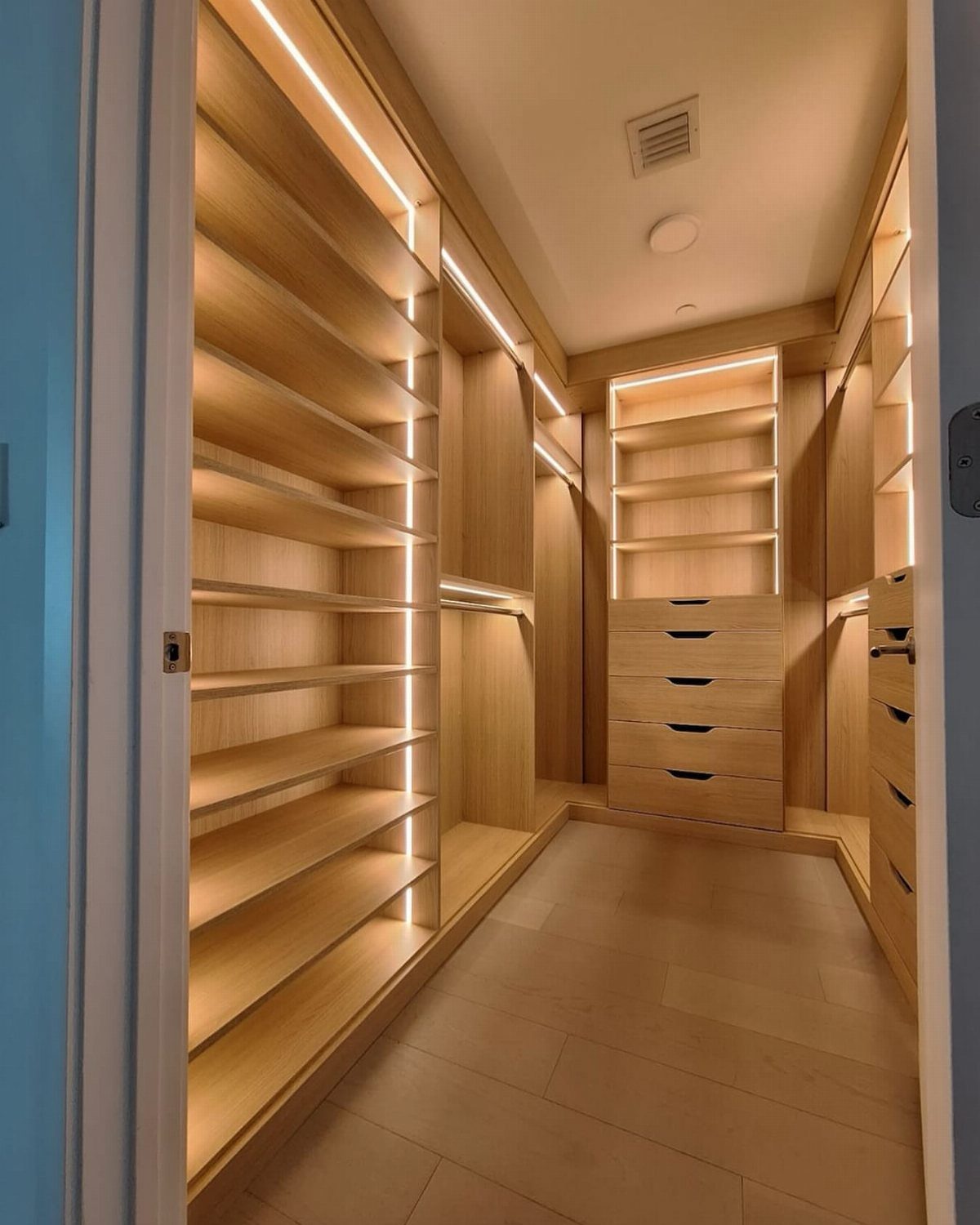
Warm LED strips run along the shelf edges, and that placement does the work: light lands on folded knits and drawer fronts instead of leaving them in shadow.
Stick-on strips are a weekend job for a renter or first-home owner, and the cost stays low next to rewiring a ceiling.
Choose a warm white tone so fabrics keep their true color. Mount each strip on the front edge of the shelf, tucked out of sight, so you see the glow and never the bulbs.
2. Add Specialty Storage
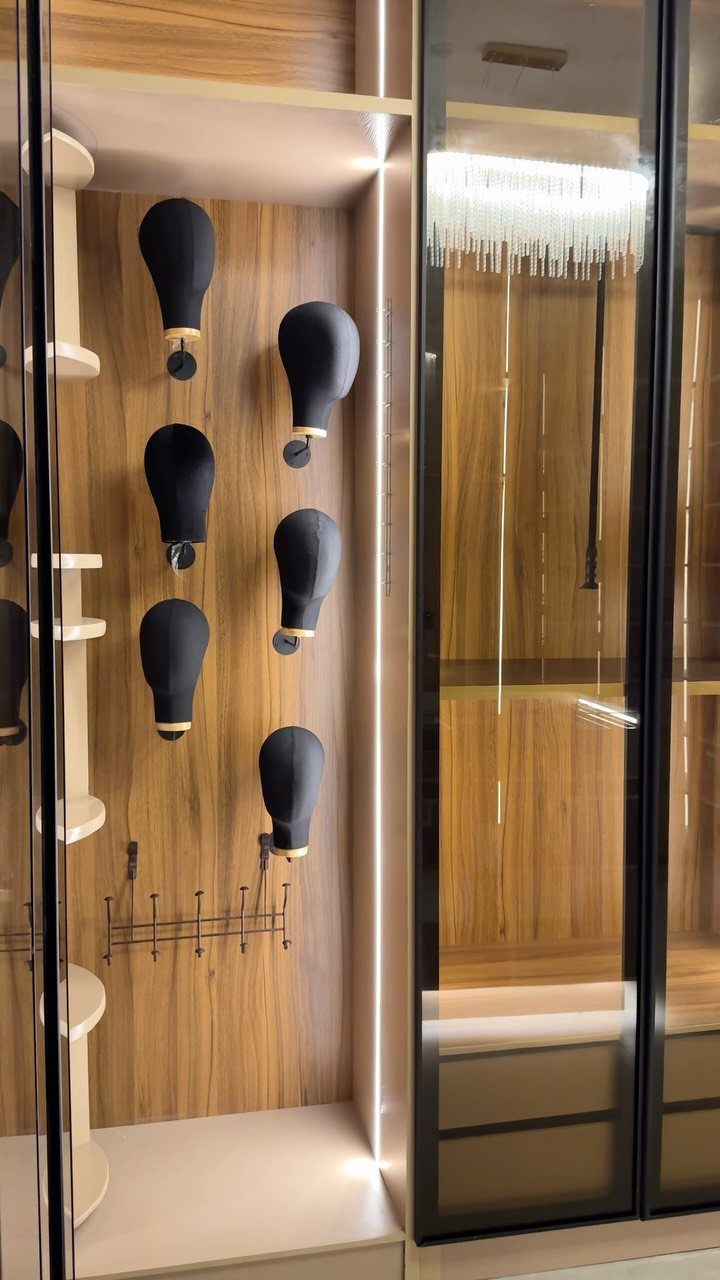
Closets built around a standard hanging rod fail the oddball items: wigs, hats, or anything with a shape that folds badly.
Wall-mounted wig heads fix that for a wig collection, and they keep each piece off a shelf where it would tangle.
Mount them at eye level on a solid surface, spaced so the hair can’t touch. A small rack below catches the extras.
I like this because it admits what you own and gives it a spot, instead of forcing it into a drawer.
3. Matching Hangers
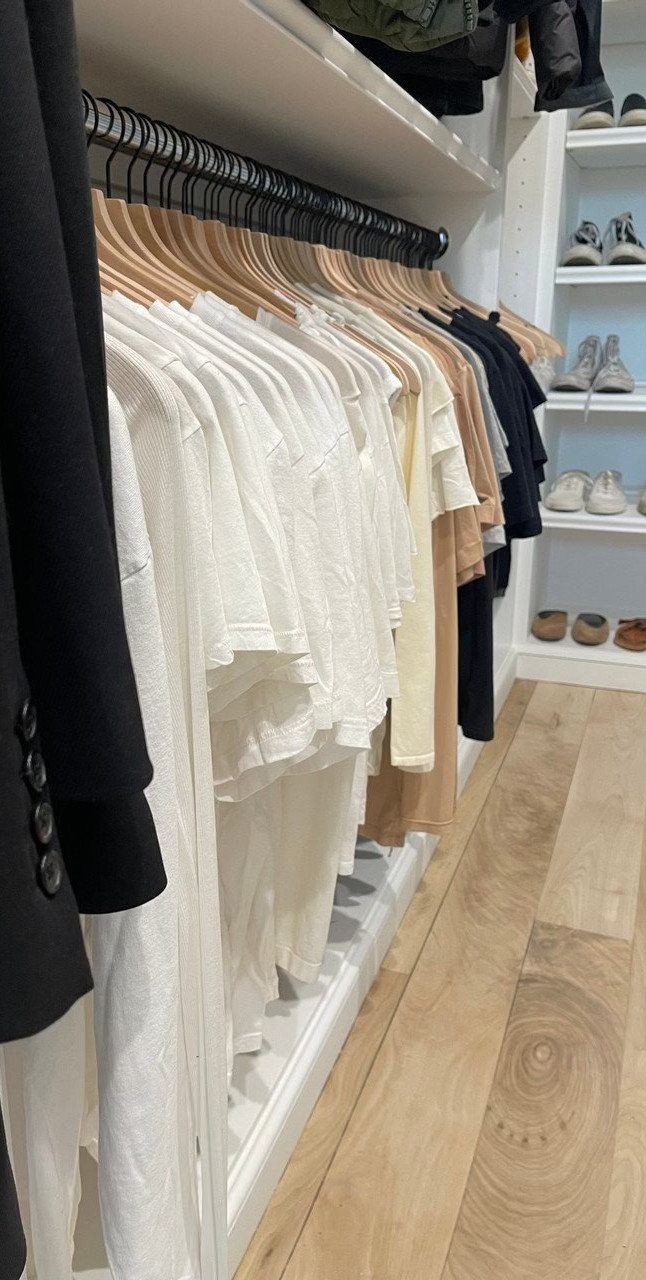
One hanger style, one row, and a closet reads as calm even when it’s full. Wooden hangers are my pick: they hold the shoulders of heavier pieces better than thin wire and look good in plain sight.
Swap them in a section at a time rather than buying 60 at once. Start with the clothes you wear most, so the change shows up in your daily routine right away.
The tradeoff: wood hangers are bulkier, so the rod holds slightly fewer garments.
4. Double Hanging Rods
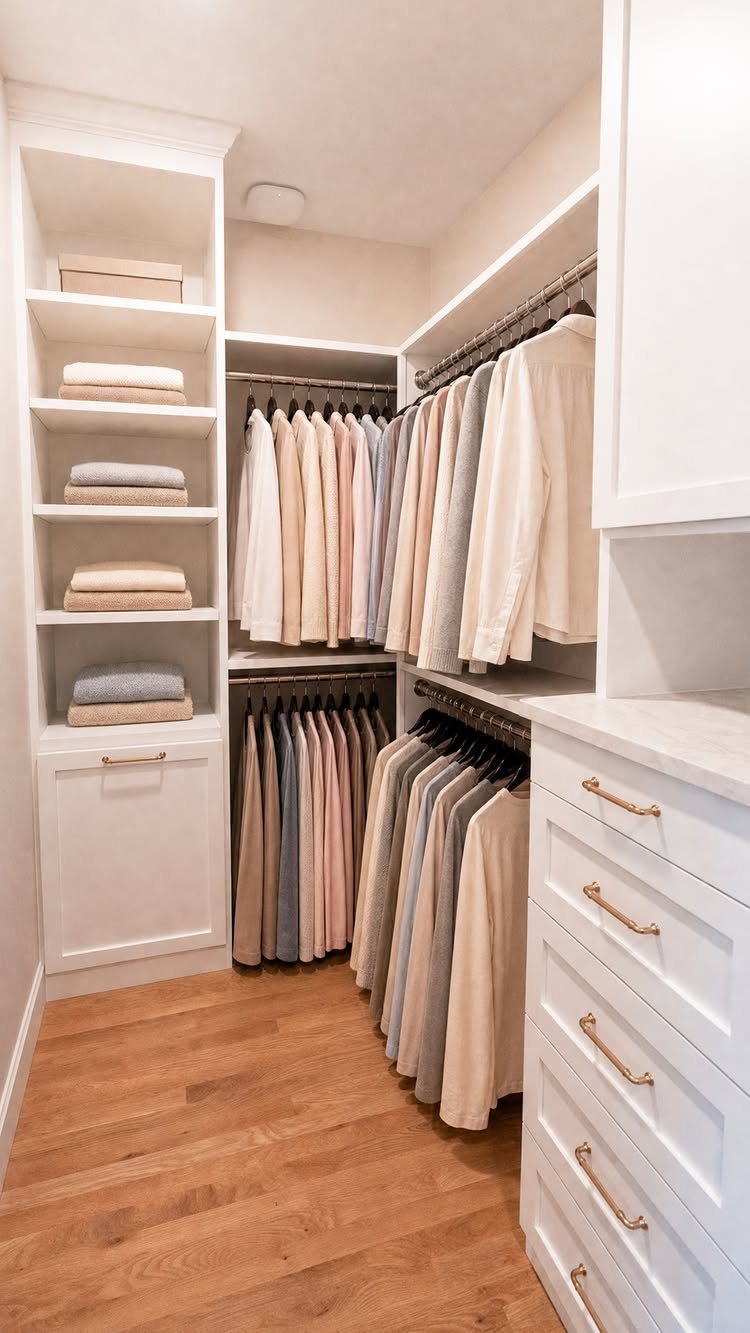
Most walls hold a single rod with a lot of dead air beneath it. Hang a second rod below the first and shirts, skirts, and folded pants can take up that space, nearly doubling your hanging room.
Reserve the top rod for items you wear less, and the lower one for daily wear so nothing needs a stool.
Long dresses and coats won’t fit under a top rod, so keep one section of full-height hanging.
5. Use Closet Doors for Storage
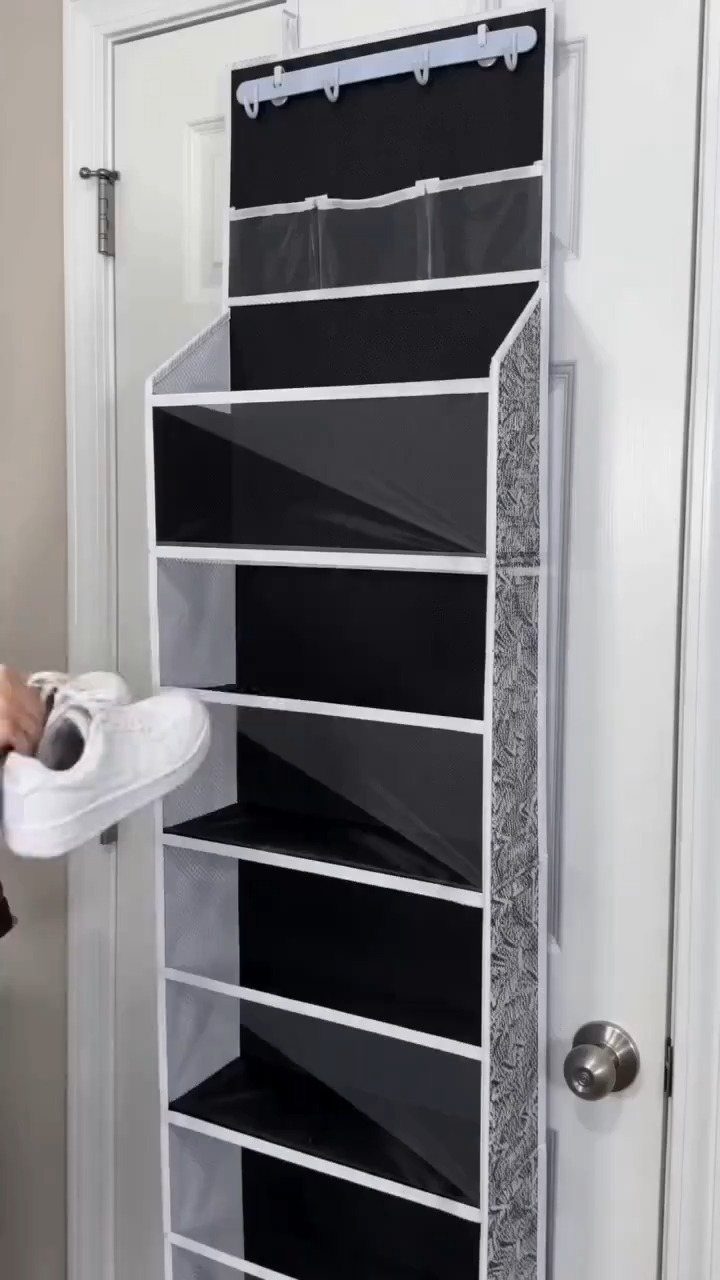
A closet door is unused wall that moves with you. An over-the-door shoe organizer hooks on the top edge, needs no drilling, and suits renters well.
Pockets also hold scarves, belts, or small accessories, so they aren’t just for sneakers. Measure your door thickness before buying so the hooks sit flush and the door still closes.
Expect a little rattle and some swing, since the organizer hangs loose. Skip it for heavy boots, which will sag the pockets.
6. Add a Seating Area
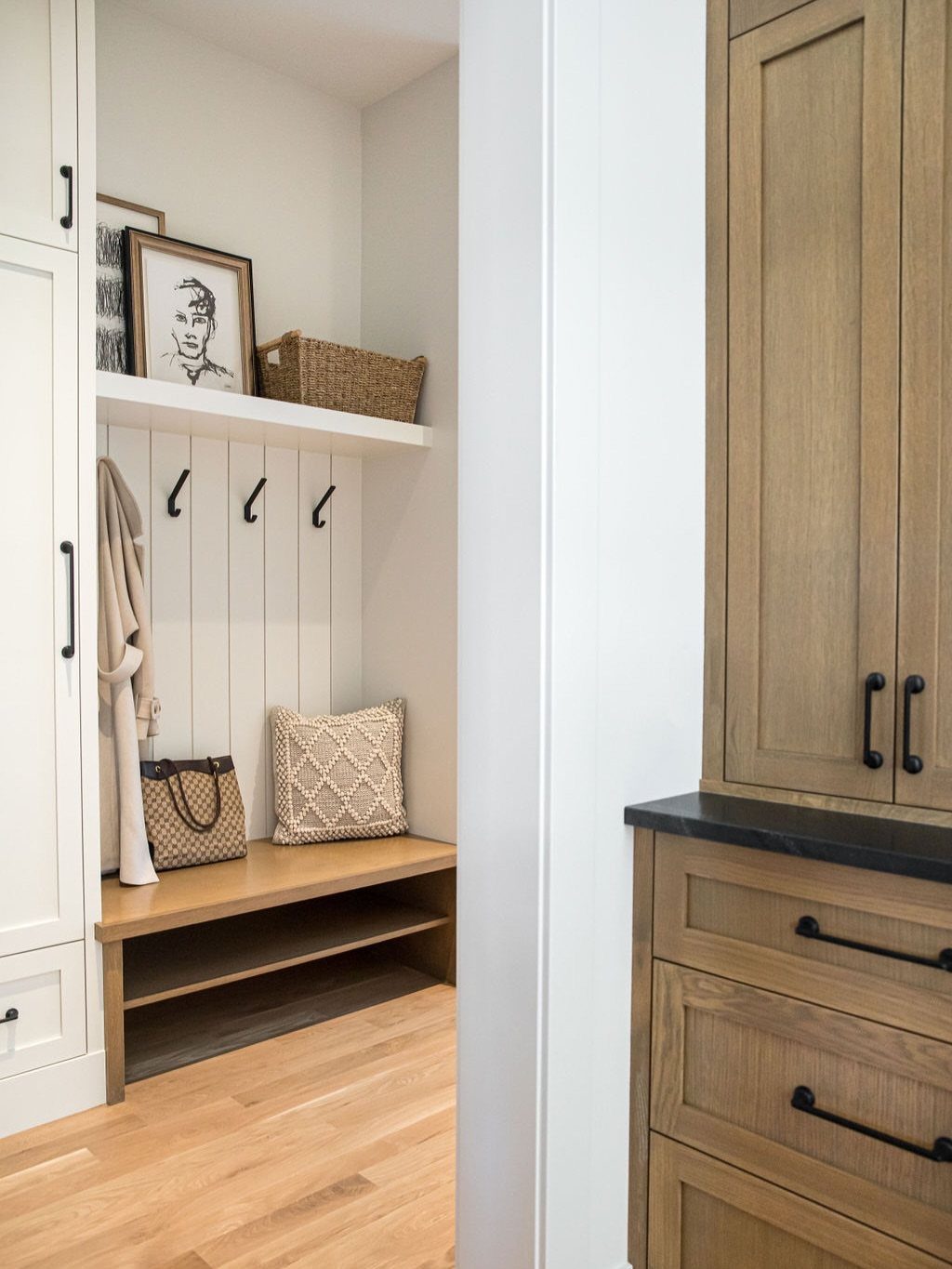
A bench inside a walk-in closet gives you somewhere to sit for shoes and socks, and it can hold storage too.
If a built-in is beyond your budget, a freestanding bench or ottoman does the same job and moves with you. Pick a cushion you can wipe or wash.
Leave enough floor in front so the bench doesn’t block drawers or a door.
7. Create a Jewelry Storage Solution
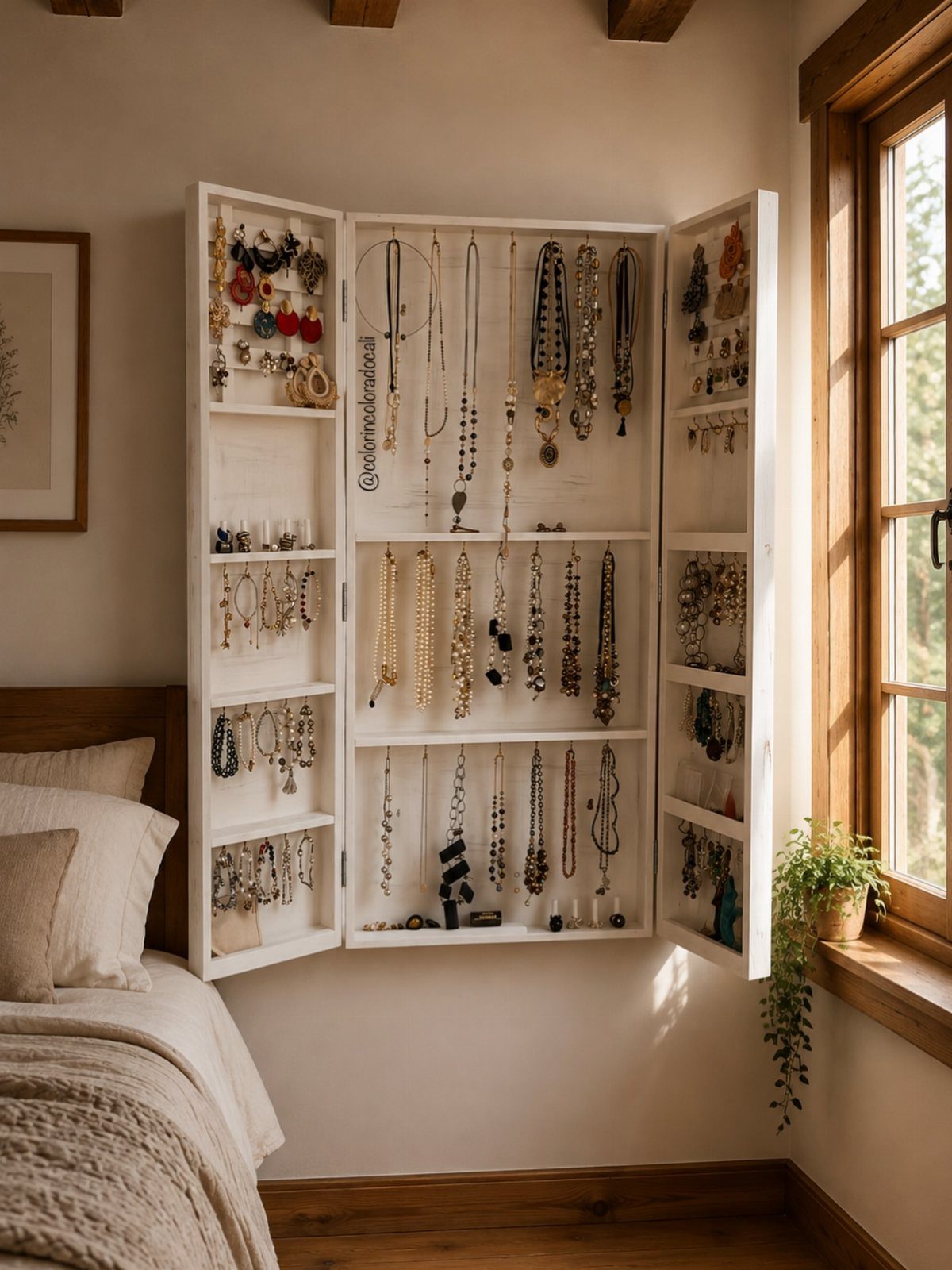
Tangled chains are mostly a storage problem, not a jewelry problem. A wall-mounted cabinet with doors keeps necklaces hanging on their own hooks and earrings in their own spots, so nothing knots in a drawer.
Hang each necklace separately, with the longest pieces on the lowest hooks. Mount the cabinet into a stud or use wall anchors rated for the full weight, since a loaded door pulls outward when it swings open.
A closed door also keeps dust off everything, which I like.
8. Custom Built-In Shelves and Drawers
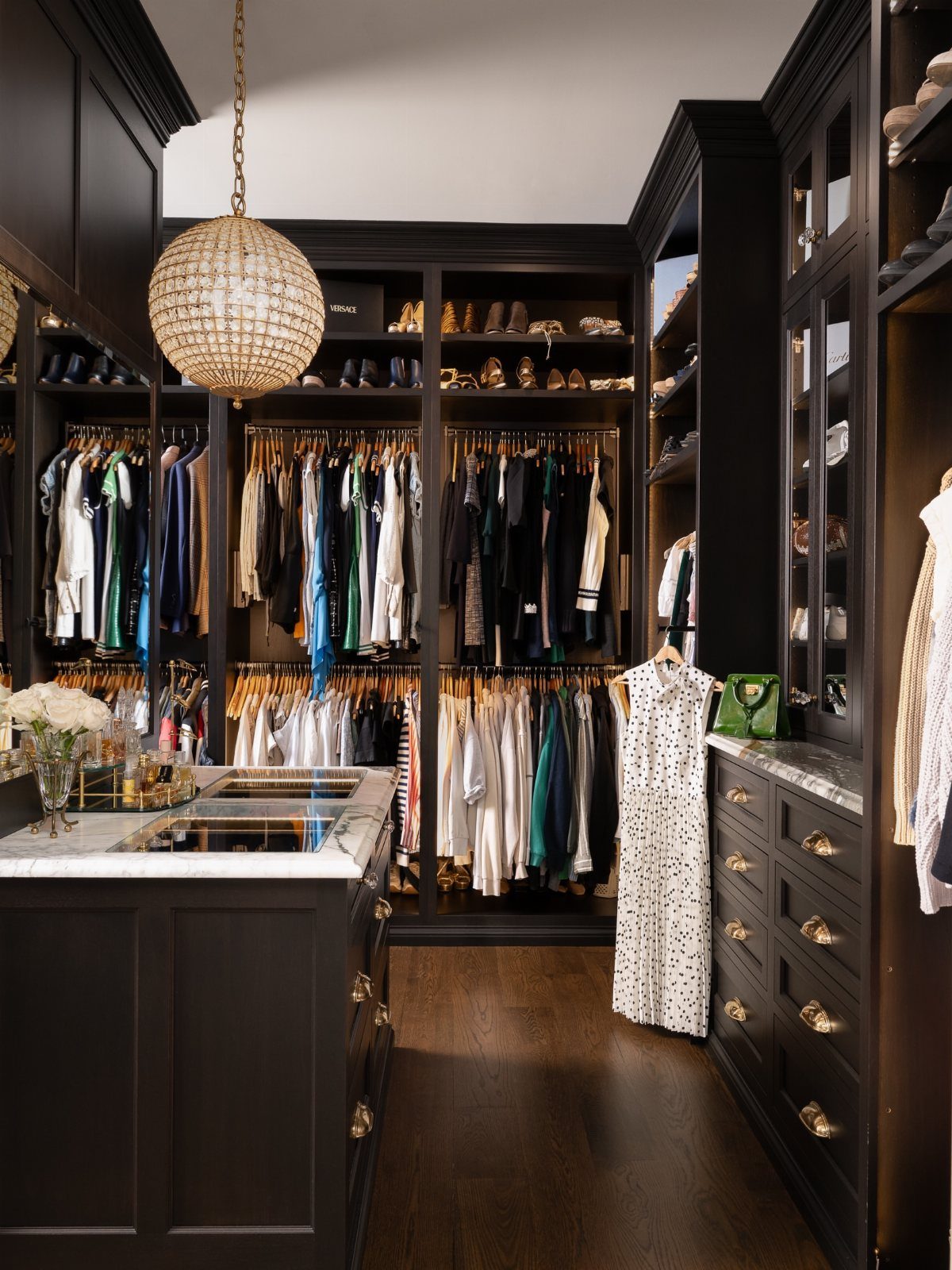
Black cabinetry makes a walk-in closet look planned instead of filled. Custom shelves, drawers, and hanging rods split the space by what you own: long hanging on one wall, short hanging stacked above and below, drawers for folded pieces.
Measure your clothes first, then size each zone to match. A full-custom build is a big spend, so a budget version uses modular units in one finish with trim added to tie them together.
Dark finishes show dust, so plan on wiping shelves regularly.
A custom walk-in closet can transform your daily routine and maximize every inch of your storage space.
9. Central Storage Island
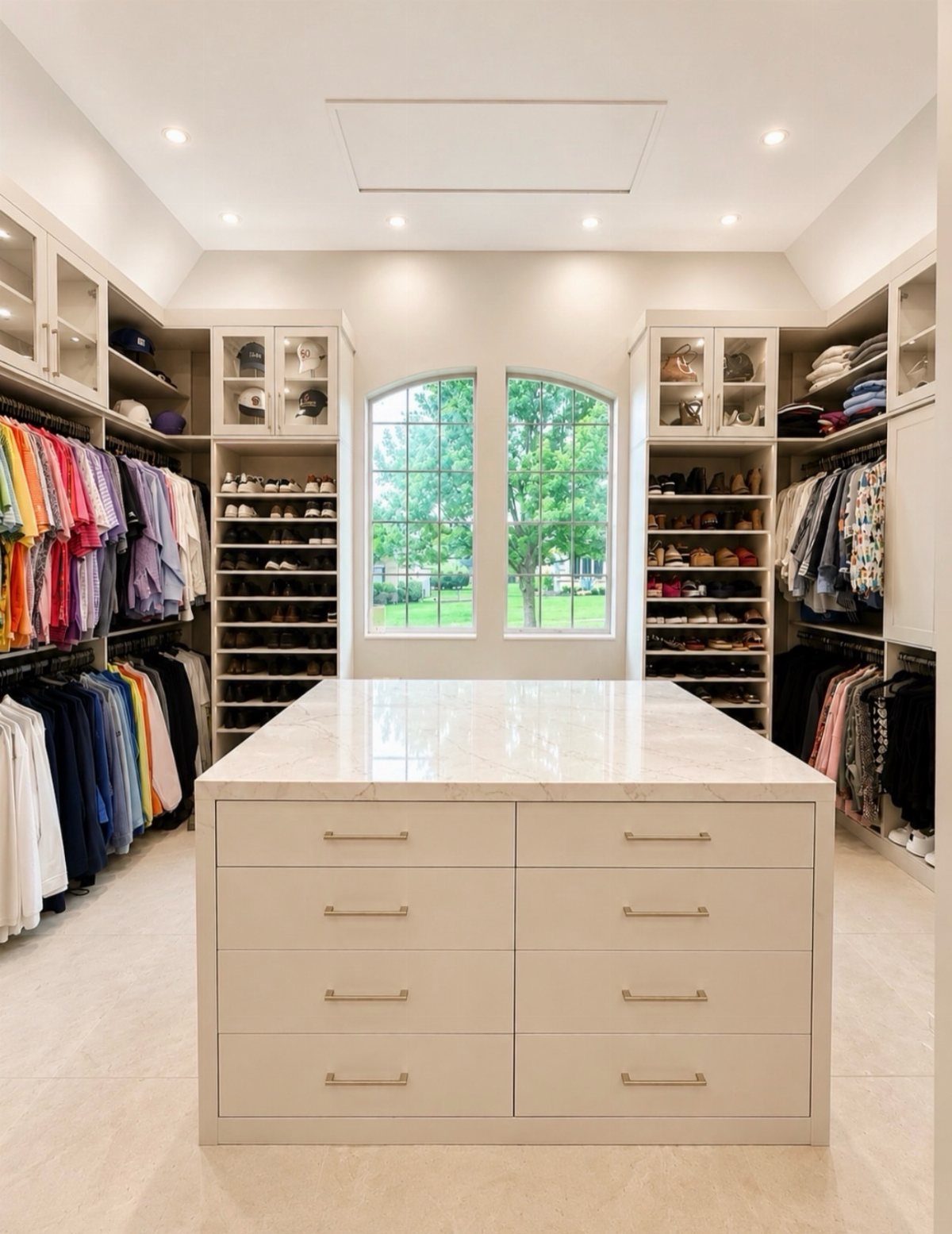
A marble-topped island with drawers gives a big walk-in a center, and the drawers hold what hanging space can’t: folded knits, belts, socks.
The flat top is the real prize. You can lay out an outfit, pack a bag, or sort laundry without carrying things to the bed.
Leave enough clearance on every side to open drawers fully and still walk past. If the room is too tight for that, skip the island and add drawers along a wall instead.
10. Built-In Vanity Station
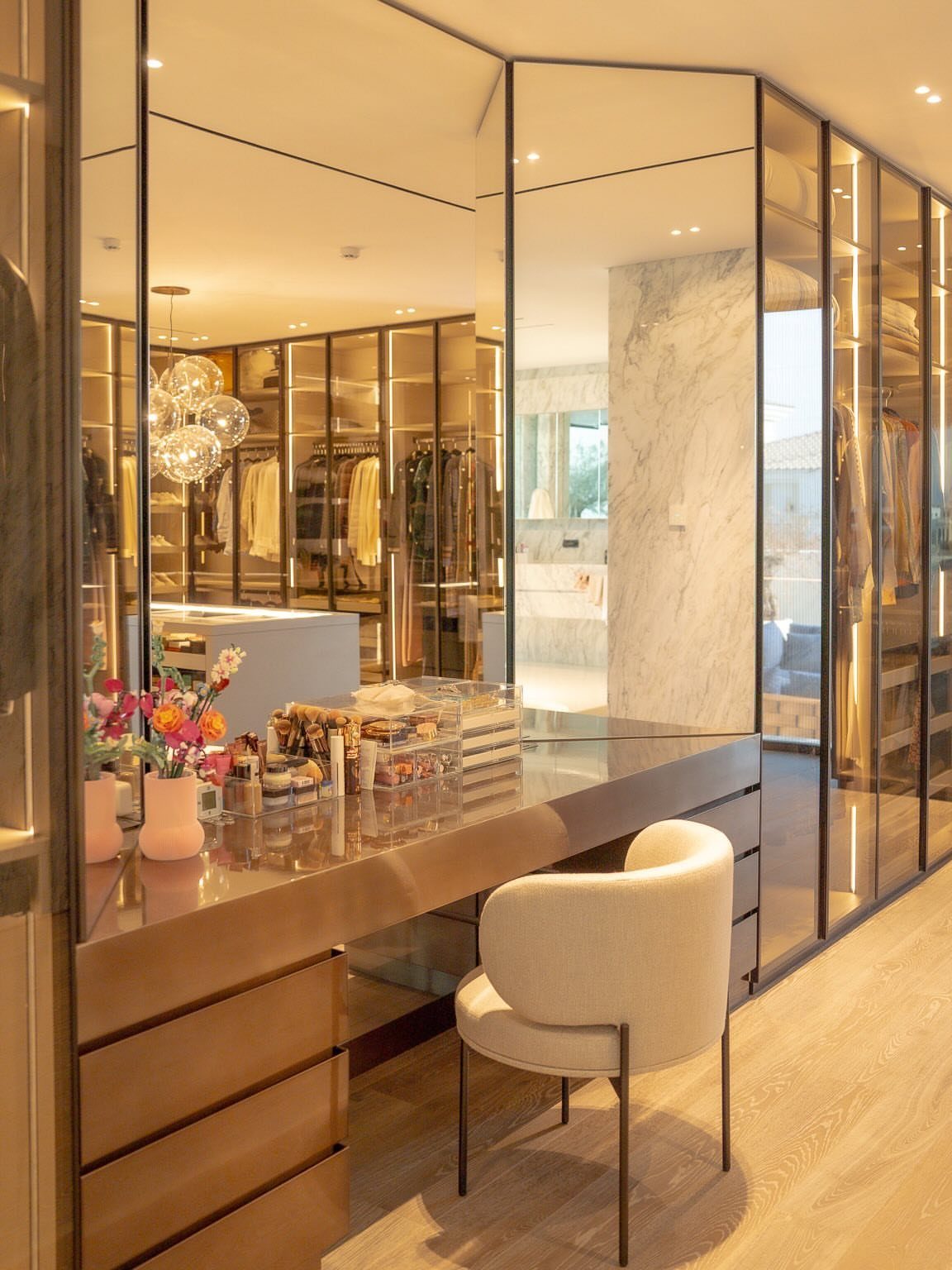
A vanity tucked into the closet puts your mirror, your chair, and your clothes within one step of each other, so getting dressed and doing your hair happen in one place.
Good light matters more than a big mirror. Glass-fronted wardrobes with built-in lighting let you see what’s inside without opening anything, and they keep dust off the pieces you display.
For a rental, a slim desk, a mirror, and a plug-in light give most of the effect without any construction.
11. Dedicated Shoe Shelving
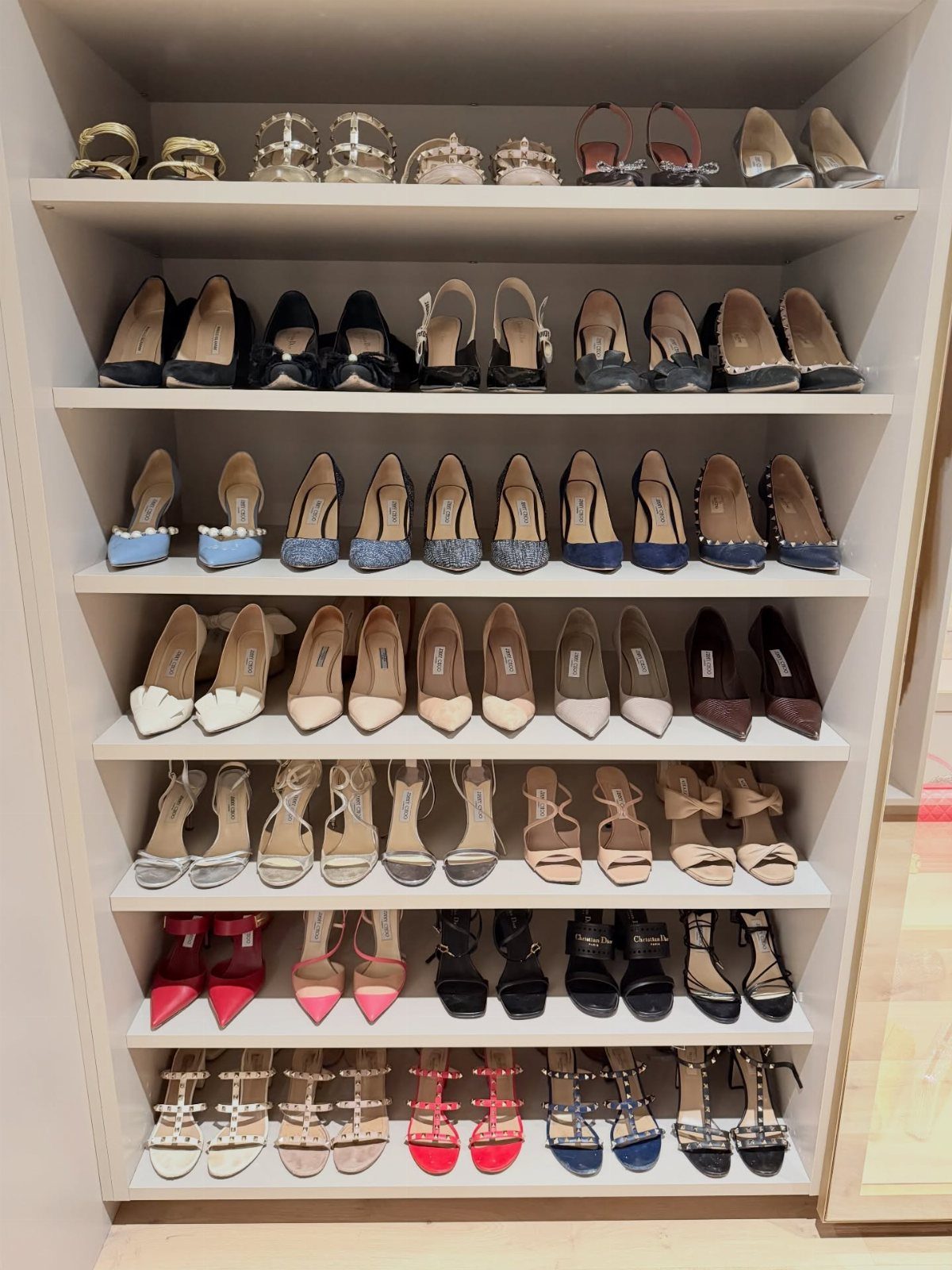
Shoes need their own shelves, and floor-to-ceiling open units do it best: every pair is visible, so you stop wearing the same three.
Space the shelves to fit what you own. Heels and sandals need less height than boots, so adjustable shelves beat fixed ones if you can find them.
Set pairs in a single row, toes out, and nothing gets crushed. Open shelving does collect dust, so wipe it down now and then.
Importance of Closet Organization
A closet shapes the first and last few minutes of your day.
A closet with clear sightlines turns getting dressed into a quick pick instead of a search, and a jumbled one adds a bit of stress to a morning that doesn’t need any.
Many people treat the closet as more than storage: it’s where you pick an outfit you feel good in and where you let the day go at night. That’s reason enough to spend a weekend and some money on it.
Build the system around how you live and dress, not around a checklist from someone else’s closet. If you always grab the same 10 pieces, give them the easiest spot to reach.
Flexibility in Closet Design
A fixed layout becomes a limit once your wardrobe, job, or home changes.
Choose parts that adjust: modular systems you can rearrange without a remodel, adjustable shelves, bins with removable dividers, and rods that slide or move.
Before buying anything, measure the closet’s height, width, and depth. Note windows, doors, and outlets, since they limit where units can go.
Then declutter first.
List what you store: long and short hanging, folded clothes, small items, shoes, and any ties, belts, or jewelry. Put the pieces you use often within easy reach and the rest further back.
Decorative Touches
Treat the closet like any other room in your home, once it works. A few decorative touches make it a space you like being in.
Start with the finish. A smooth, sealed finish protects the wood, looks more finished, and stops sweaters and knits from catching on splinters.
After that, add the personal layer: wallpaper on one wall, a piece of art, or a light fixture you’d put in a bedroom. Pick one or two, not all three, so the closet doesn’t feel busy.
Puck lights are another option for highlighting one area, and they suit shelving that needs a spotlight.





