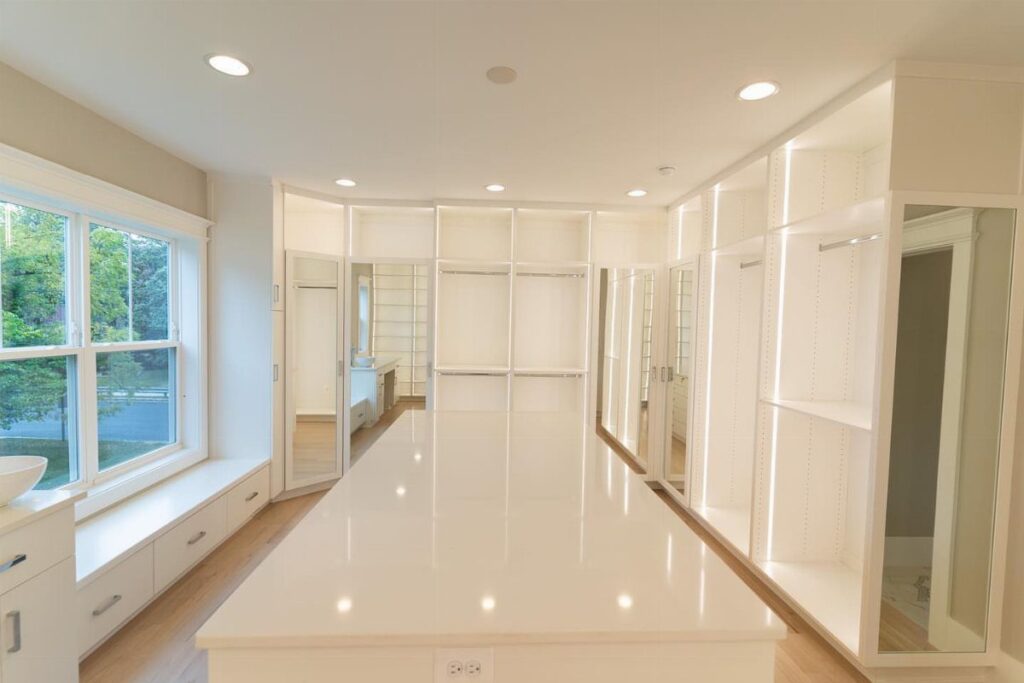
Which recessed lighting suits a closet depends on what you can do to the ceiling and the shelves: a renter with no power run for extra fixtures is limited to rechargeable LED lights, while an owner can cut in pot lights, linear strips or a routed groove in a shelf panel.
Round pot lights are the cheap, easy end of the range, and linear strips sit at the other end: they cost more and take more work to fit.
Whatever you pick, bulbs rated 2700K–3000K keep a closet warm, and a black sock held next to a navy one tells you fast whether the light is right.
1. Recessed Lighting
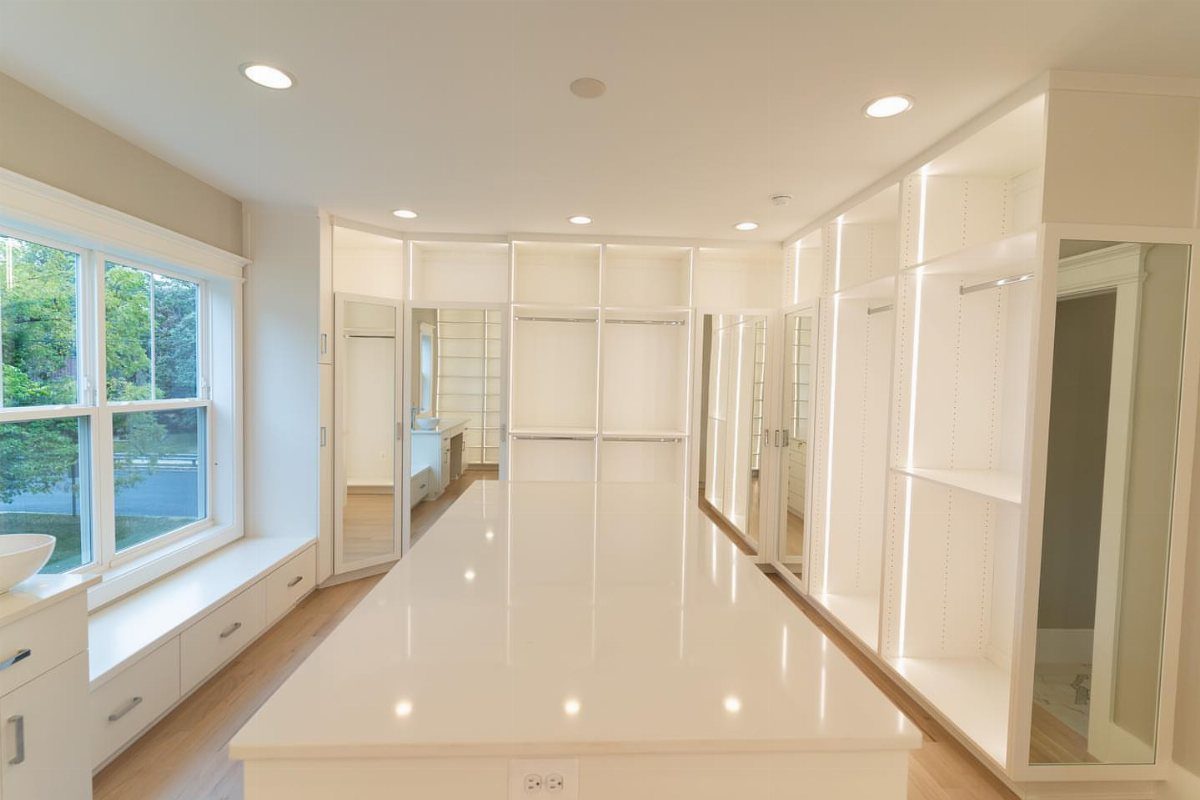
Flush-mounted fixtures leave the ceiling clean, with no shades or fixtures hanging into the room. Recessed lights suit a closet with mirrors and built-in shelving, because a bulky fixture would compete with the storage and cast shadows across the glass.
I like to space them in a loose grid over the aisle rather than over the shelves, so light falls on the clothes from the front.
A closet with a window, like this one, needs less help during the day, so put the lights on a dimmer.
2. Task Lighting
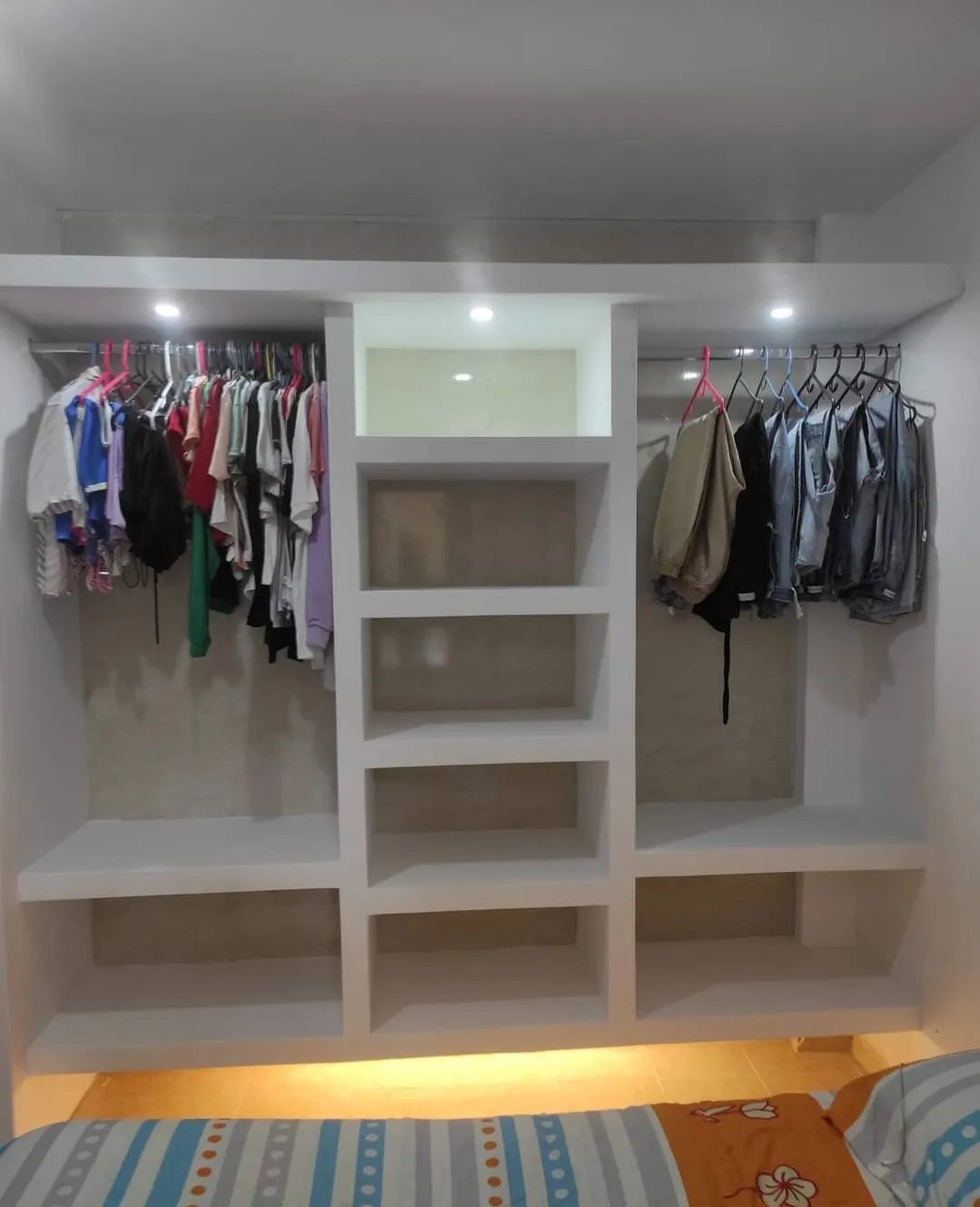
Aim the light at the things you grab every morning: the hanging rods and the shelves. Recessed task lighting does that by putting a fixture directly over each section instead of one bulb in the middle of the room.
Place lights in front of the clothes, not behind them, or hangers will cast shadows on the garments.
Three recessed lights over one built-in run is a sensible count for a single wall of storage, spaced evenly so no shelf sits in shadow.
For a small reach-in, I would pick this over a single ceiling light every time.
3. Recessed Ceiling Pot Lights
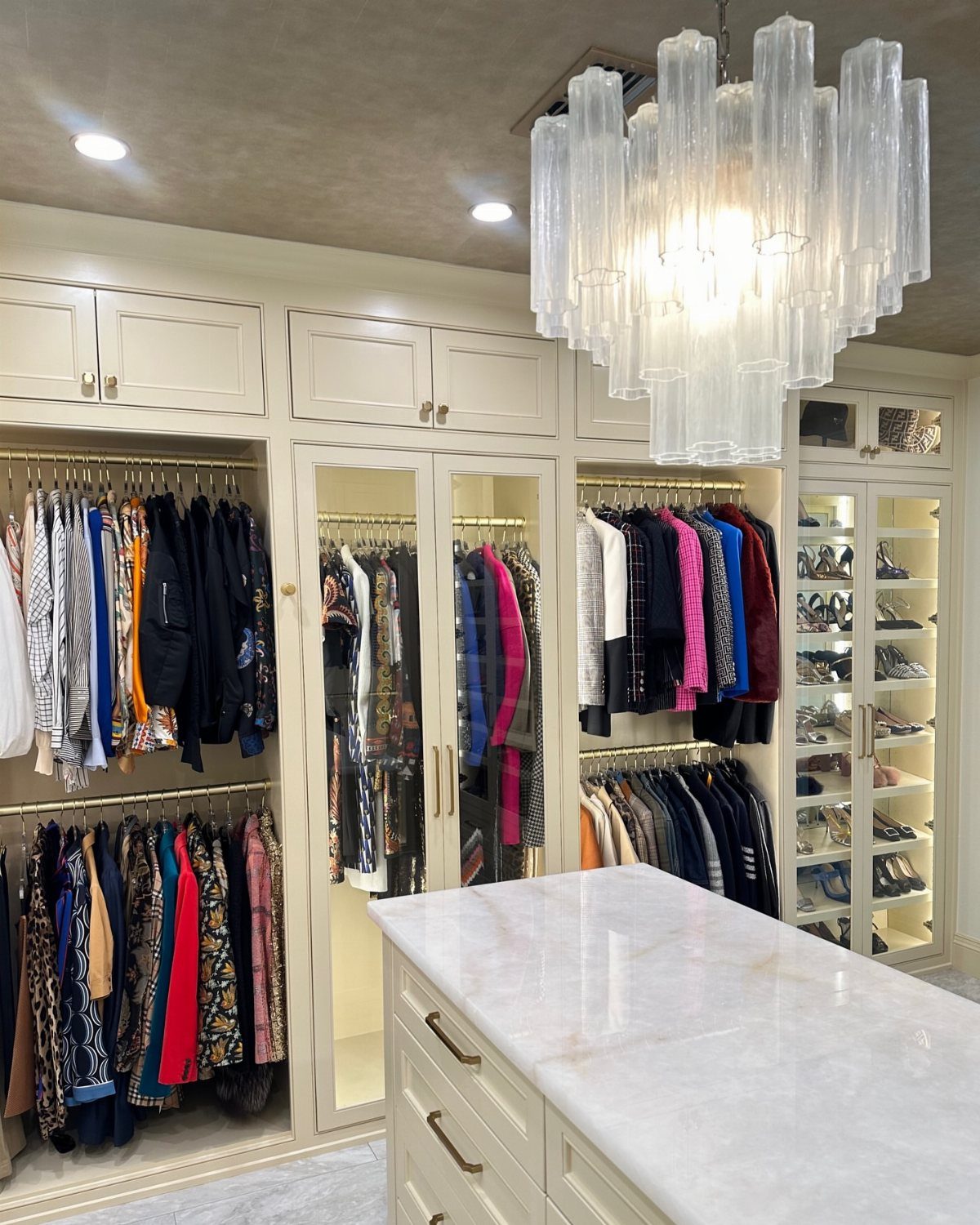
Small round pot lights are the standard choice for a closet with white cabinetry, because they bounce light off the cabinet fronts and brighten the whole room.
Keep them evenly spaced along the walkway and a little off the cabinet faces so doors and drawers don’t sit in shadow.
A pot light works fine alongside a decorative fixture, such as a chandelier over an island, since each does a different job.
Pick one bulb color for every fixture. Mixed tones make white cabinets look patchy.
4. Recessed Linear Ceiling Lights
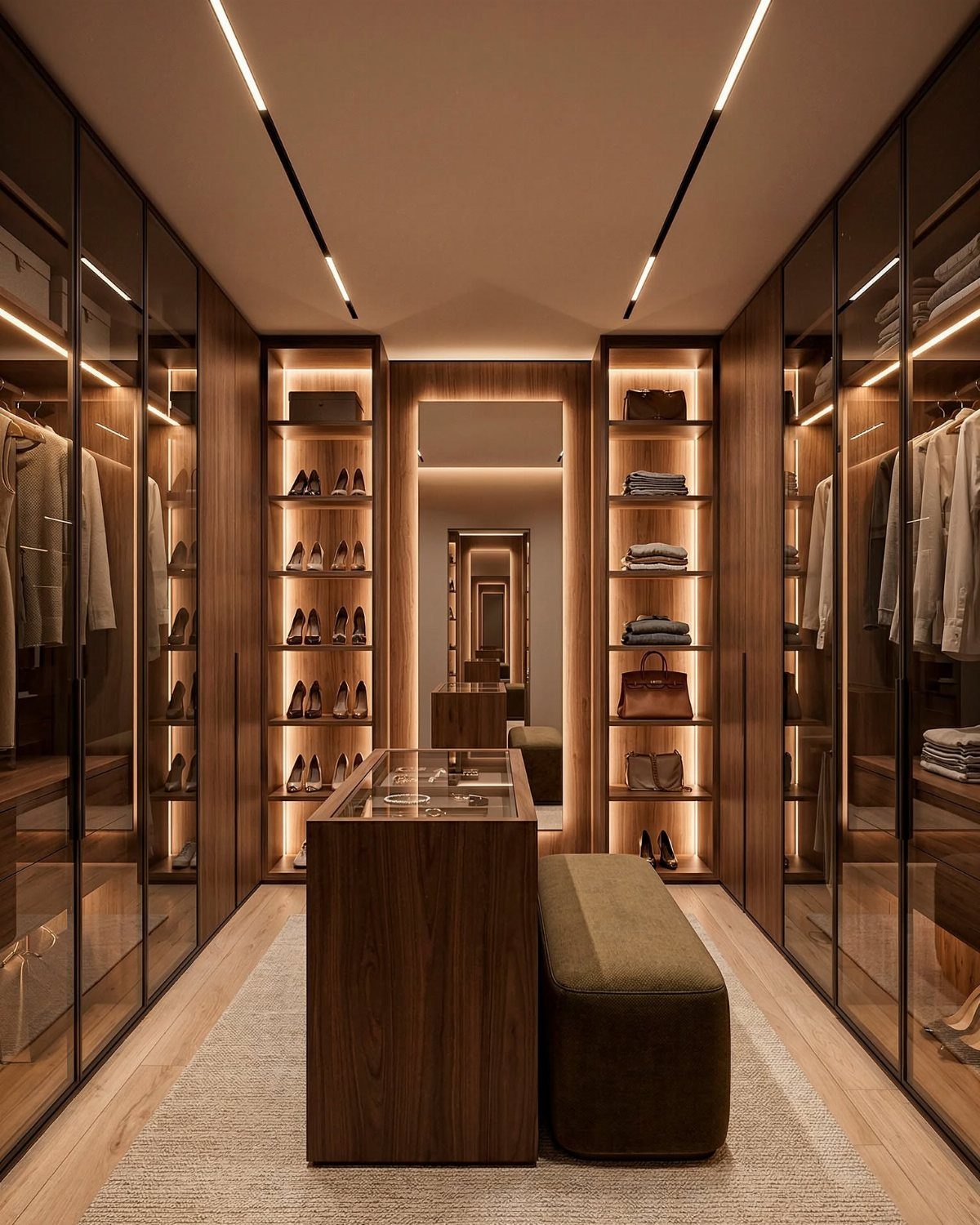
Linear recessed strips draw long, straight lines of light across the ceiling, and they pair well with dark wood cabinetry, where a row of round spots can look dotted and busy.
Run them parallel to the cabinet runs so the light lines up with the storage. In a closet with an island, 2 strips can frame it neatly.
They cost more and are harder to fit than basic pot lights, so I’d save them for a closet where the look is the point. Add shelf lighting only if you want extra glow on displayed items.
5. Recessed Shelf Strip Lighting
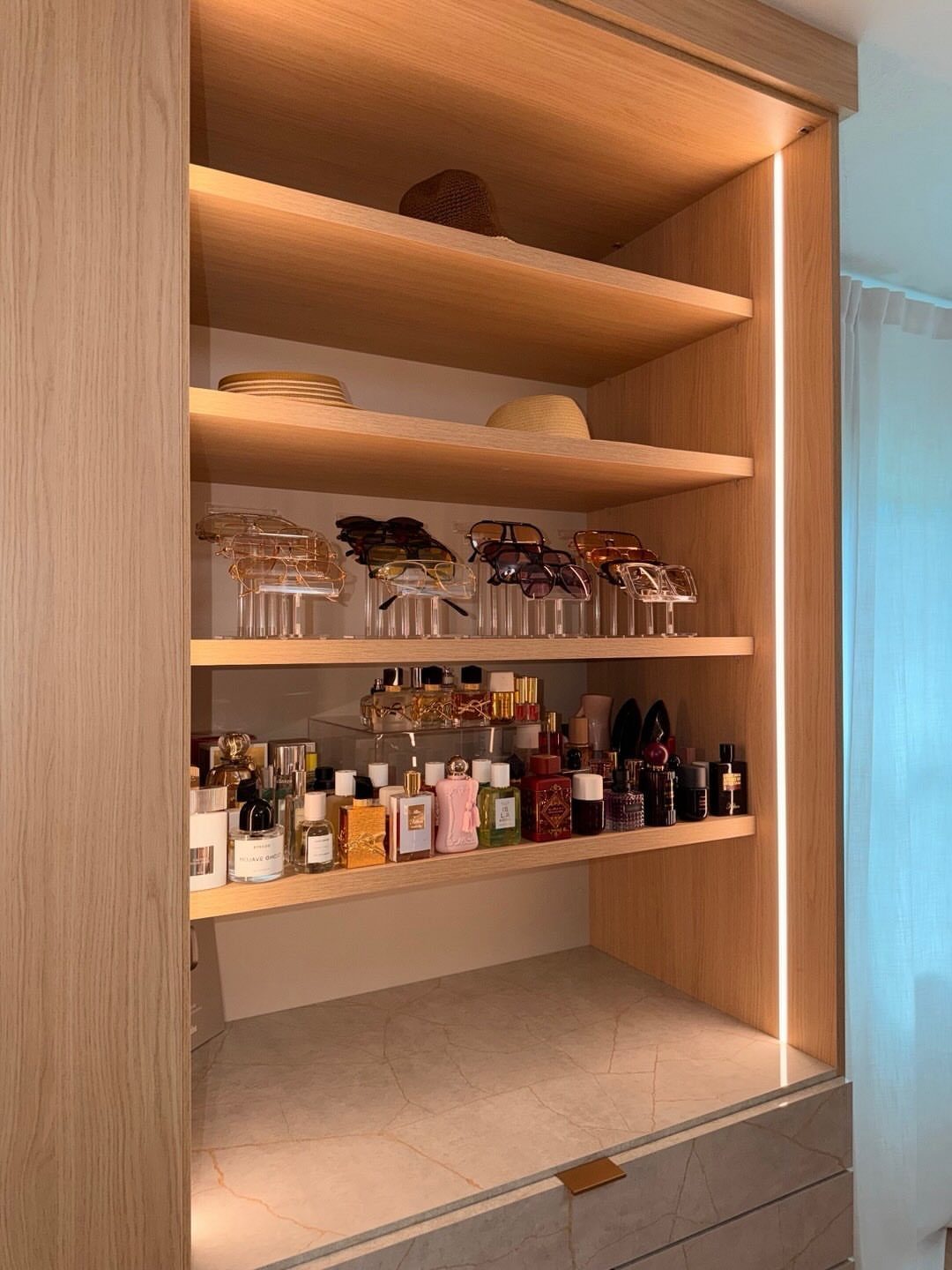
A vertical LED strip set into the side panel of a shelf lights small things from the edge, which is exactly what perfume bottles, sunglasses and hats need.
Recessing the strip into a routed groove hides the strip itself, so you see only the glow. Plan the groove before assembly, since cutting into finished panels is much harder.
Ceiling lights alone leave shelves dim in the back. This fixes that, and I’d choose it for any display shelf you want to show off.
Choosing the Right Fixtures
Brightness, shadow placement and color temperature decide whether a closet is easy to use, and the fixture style matters less than all three.
Pick bulbs rated 2700K–3000K if you want a warm, easy glow in a closet; save 4000K–5000K for kitchens, offices, and other places where you do detailed work.
A closet is a dressing room and a task space at once, so I would lean toward the middle of that spread and check how navy and black clothes read under it before committing.
Adjustable color temperature fixtures let you change the tone through the day, which helps if you can’t settle on one.
Test one bulb first. Hold a black sock and a navy sock under it, and if you can’t tell them apart, the light needs adjusting.
Smart Lighting Solutions
Dimmable bulbs are the cheapest upgrade here: full brightness for finding a black sweater, a softer glow for putting things away at night.
Smart bulbs add control by app or by voice through Alexa or Google Home.
With smart bulbs or a smart dimmer, a phone or voice command handles on and off, brightness, and even color temperature, so the wall switch stops being the only control.
In a closet with no power run for extra fixtures, rechargeable LED lights are what I’d pick as a renter.
No wiring is involved, and they fit inside cabinets, along shelf edges, or beneath a hanging rod. Some include motion sensors, so they switch on as you open the door.
I would skip smart bulbs in any fixture on a wall dimmer, since the two can fight each other. Pick one control method per light.
The light quality is unmatched, with soft, even illumination and buttery-smooth fade-ins and transitions that make the entire closet feel elevated and intentional. If you want the best smart lighting experience available and are willing to invest the time and money, nothing else comes close.
— Bob Vila
Planning Your Lighting Layout
Plan the layout on paper before cutting any ceiling. Room size, ceiling height, and what you do in the space all affect how many lights you need and where they go.
For general light, space recessed fixtures about half your ceiling height apart.
Under an 8-foot ceiling, that puts them around 4 feet apart. Over a work surface, keep fixtures 18–24 inches off the wall or cabinet face so shadows stay soft.
Aim shelf and rod lighting from the front of what’s stored, since a light behind the clothes leaves the fronts dark.
Put mirror and dressing lights at face height or a little higher, because light coming up from below casts harsh shadows on your face.
I like pairing fixed downlights for overall light with a few adjustable heads that can be aimed at accents. Layering gives the closet depth and keeps any one fixture from doing all the work.
Frequently Asked Questions
What are some good light fixtures for walk-in closets?
Recessed lights are my first pick, with LED strips for shelves and a chandelier as an optional extra. On white cabinetry, small round pot lights work well since the glossy or pale fronts reflect the light back into the closet.
Dark wood does better with a linear recessed strip, because a row of round spots leaves a polka-dot pattern on the finish.
Should you have recessed lighting in your bedroom?
Yes, it works well when you want a clean ceiling with no fixtures hanging into the room.
Spacing for general light runs about half the ceiling height, so figure 4 feet between fixtures under an 8-foot ceiling. Put them on a dimmer so you can soften the light at night.
What is the best type of lighting for inside cabinets?
An LED strip is the best choice for cabinet interiors and shelves.
A routed groove keeps the strip out of sight so you see the glow and not the hardware; ceiling fixtures by themselves usually leave the back of a shelf in shadow.
Cut the groove before you put the pieces together, since routing a panel that is already built is a far harder job.
In a rental with no wiring, rechargeable LED lights fit inside cabinets or under a hanging rod, and some switch on with motion sensors.





