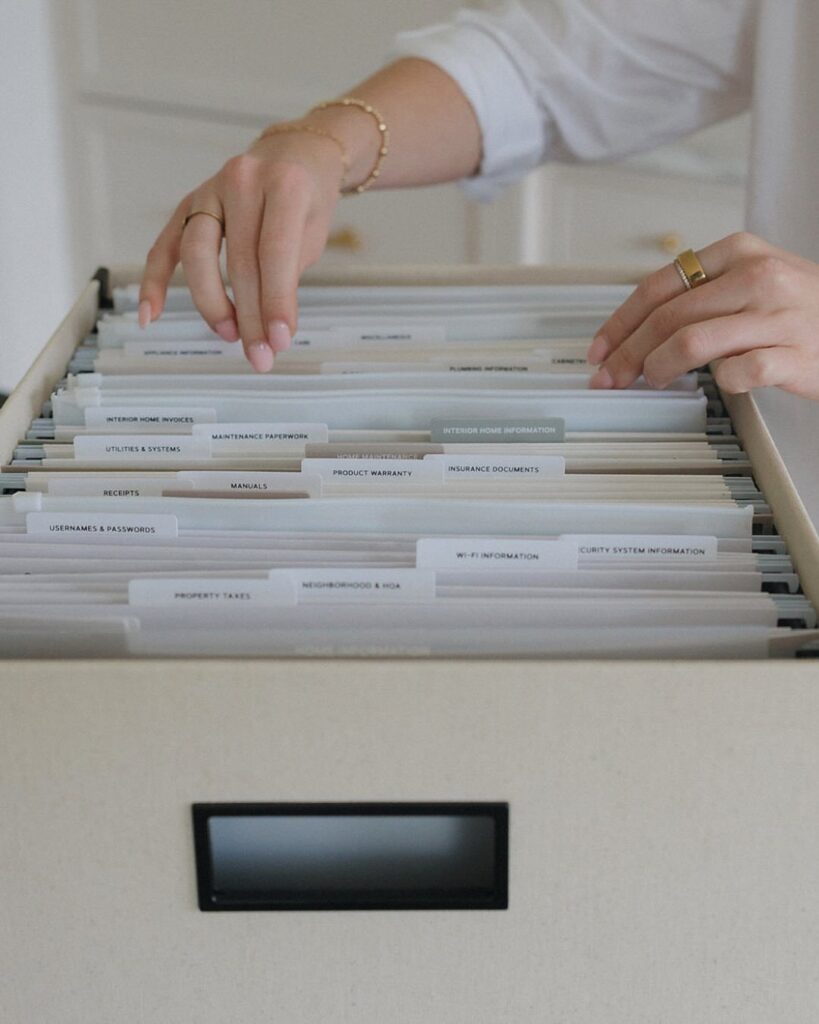
The ideas below run from a color-coded folder system that costs almost nothing to labeling habits, translucent hanging folders, a deep desk drawer setup, and the safety features that matter once the cabinet is full.
Match the setup to the paper: invoices and everyday household files need only color and a short label, private records do better in solid folders or behind a lock, and anything you could never replace belongs in a fireproof safe.
Size narrows the choice further, and the section on choosing the right size covers how much room your files and your space can actually hold.
1. Colored Folders
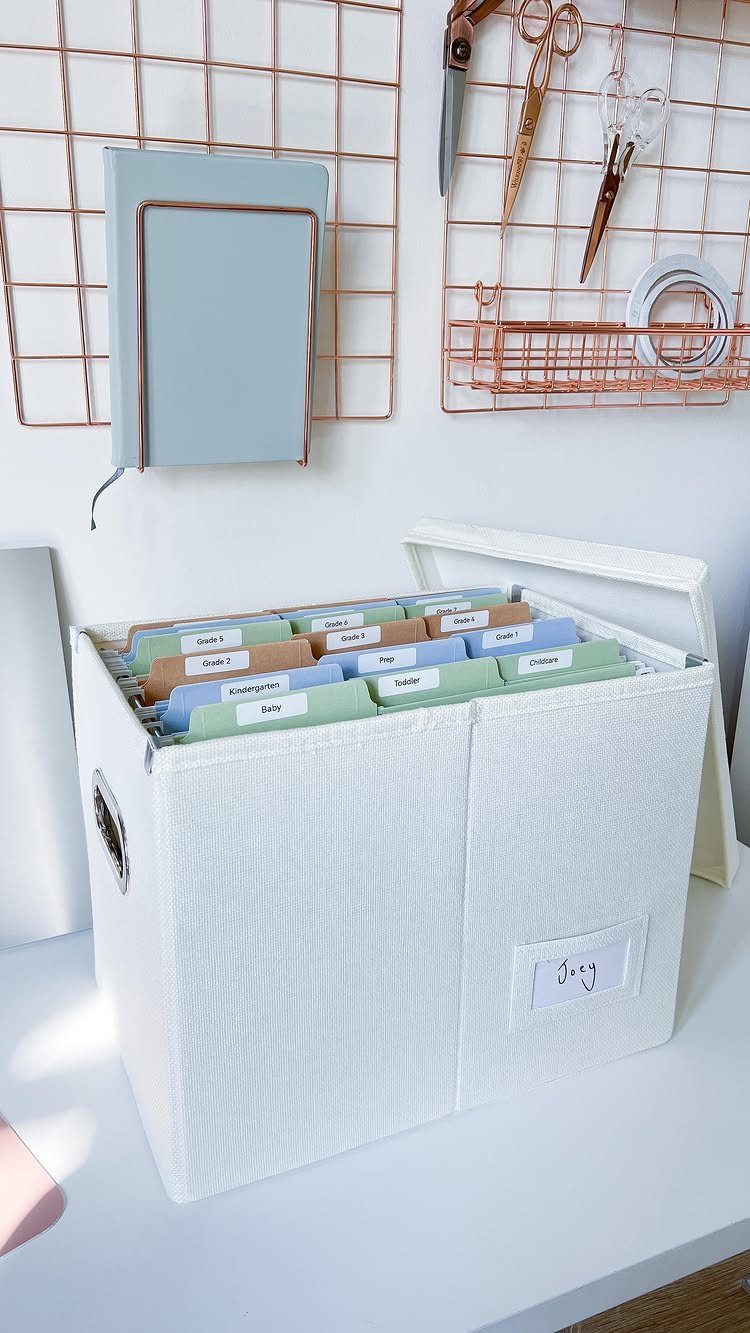
Color works as a filing system you can read from across the room. Give each category one color, such as blue for medical, green for money, yellow for home, and you stop reading tabs to find what you need.
The photo sorts by life stage, so the same logic works for a household with kids: one color per child, or per category.
I stop at a handful of colors. Past that, you’re memorizing a legend instead of saving time.
Pair color with a written label on every folder. Color gets you to the right section; the label gets you the exact file.
2. Labeling Files
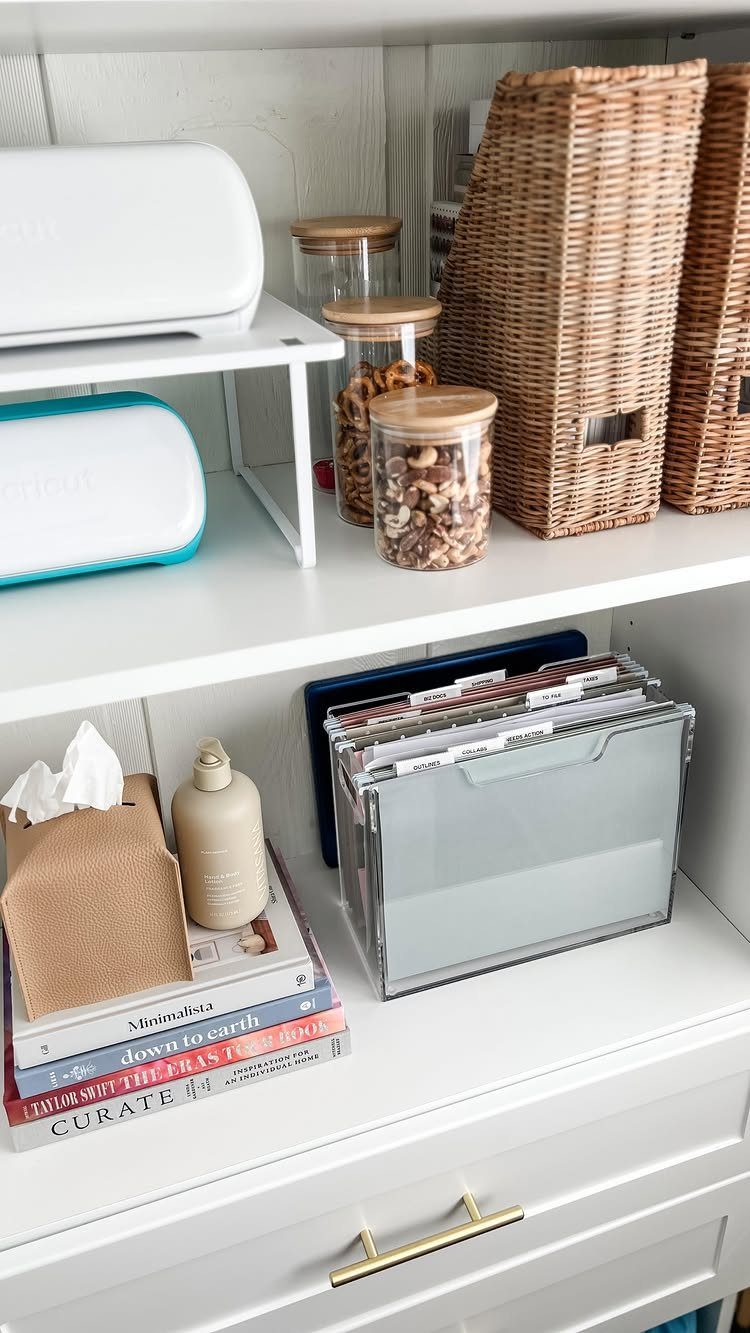
A label does the work only if you can read it at a glance, so write the category in 1–3 words and use the same wording across every folder. "Insurance" beats "Misc. policy papers" every time.
Printed labels look cleaner than handwriting, and a Cricut-style cutter or any label maker will do it. Handwriting with a thick marker is fine on a budget.
Put labels on the front edge where your eye lands first. Then sort the folders in a clear organizer alphabetically, so a new paper never needs a decision.
3. Translucent Hanging Folders
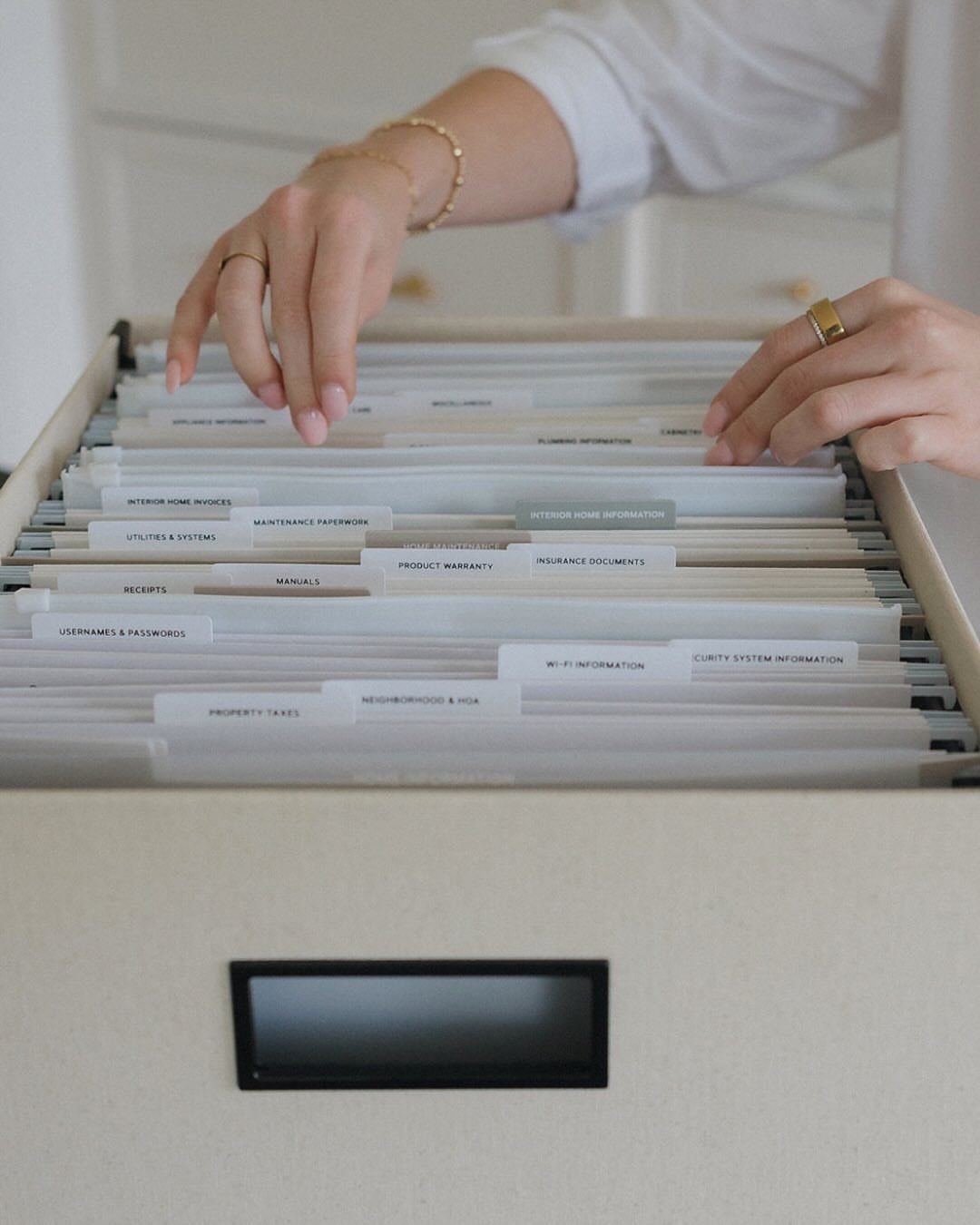
Translucent hanging folders let you see the stack inside before you pull anything out. That matters in a drawer packed with invoices, insurance papers, and a folder of passwords you need once a year.
I like them for anything you open often, since a quick glance replaces pulling and flipping. Set the tabs in a staggered row so every label stays visible, and group related files front to back, like invoices together.
The trade-off is privacy: anyone looking in can see the pages. For sensitive records, keep those in solid folders and use clear ones for the everyday stuff.
4. Deep Desk File Drawer Setup
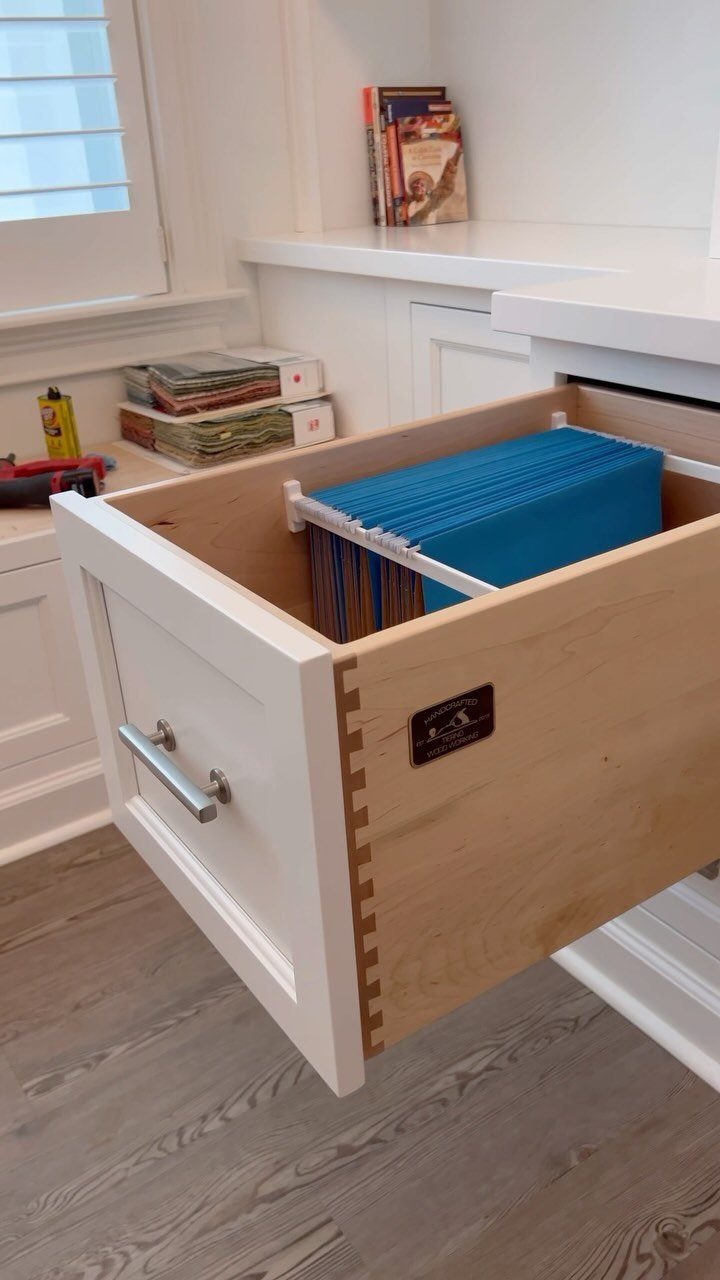
A deep desk drawer can hold hanging folders without a separate cabinet, which suits a small home office with limited space and money.
Check that the drawer is deep enough for letter-size hanging folders to sit upright without scraping the top.
Most hanging folders need a rail, so add a frame insert if the drawer has none. Folders also tend to slump when the drawer is half empty, so a few extras or a divider keep the rest standing.
Blue folders look tidy against a white drawer. Save the front slot for whatever gets used most often.
Importance of Filing Cabinets
A filing cabinet earns its spot by cutting search time. When every document has a set home, you pull a file in seconds instead of digging through piles on the desk.
A closed drawer keeps paper out of spills and sunlight, makes it harder to lose, and puts it out of sight in a way a pile on the counter never will.
If you run a small business from home, a proper filing system makes it much easier to find what you need for an audit or inspection.
Safety Features
Fireproof cabinets are the pick for sensitive, highly important paperwork. Truly valuable materials belong in a fireproof safe instead.
Tall cabinets should have an anti-tip interlock, a catch that holds every other drawer shut while one is open so the weight can’t pull the cabinet forward.
With several full drawers pulled out at once, a tall unit can fall over and cause serious injury. Counterbalance weights, usually concrete or another heavy material built into the base, add more stability.
Plenty of cabinets ship without a lock, so check the spec sheet before you buy if you want one.
Some models use one central lock and a single key to secure every drawer, while others only lock the top drawer or a couple of them.
Choosing the Right Size
Start by measuring the spot where the cabinet will sit, and leave clearance so the drawers can open fully. Then estimate how many documents you actually need to store.
Lateral cabinets pull out less, so the drawers need less clearance in front, though the cabinet itself is much wider. Vertical cabinets need more clearance in front but take up less wall space.
For a small or flexible workspace, a mobile cabinet slides under a desk. Whatever size you pick, look for ball-bearing suspension so drawers glide, and rust-resistant metal for durability.
Frequently Asked Questions
How do I arrange the order of files in a folder?
Sort the folders alphabetically, using the same 1–3 word category wording on every label.
A new paper then never needs a decision, because its spot is already set. Tabs and labels along the front edge are the first thing your eye hits, so the sequence reads at a glance.
How does a filing cabinet work?
A filing cabinet stores documents in drawers, usually in hanging folders that sit on rails, so each paper has a set home. A closed drawer also shields paper from spills and sun fade.





